The shopping spark often comes from anticipation, choice, and progress before ownership.
Dopamine shopping site
A dopamine shopping site for the spark of browsing without the spending spiral
Learn how DreamCheckout works as a dopamine shopping site: product discovery, virtual carts, fake checkout, stress-shopping relief, and safer boundaries before real money moves.
DreamCheckout keeps the dopamine loop inside a clearly marked fake checkout experience.
Use the spark as information, then decide later whether anything deserves real money.
The fun part of shopping is anticipation
Product discovery creates tiny promises: a better room, sharper outfit, calmer routine, cleaner desk, or small reward. DreamCheckout lets that anticipation happen without forcing a real purchase.
A safer container for stress-shopping energy
The simulator gives the urge a path: browse, choose, cart, fake checkout, tracking, and reflection. The familiar loop gets closure while real payment stays out of the moment.
Not therapy, not a retailer
DreamCheckout can support a pause and reveal patterns, but it does not diagnose, treat, sell, ship, or replace professional help when shopping feels out of control.
Product discovery, ratings, carts, and checkout create a rewarding sense of possibility before ownership begins.
DreamCheckout keeps the enjoyable dopamine loop visible while separating it from real payment and shipping.
A short simulated shopping session can become a contained break instead of an unplanned spending spiral.
The products that pull attention can reveal the emotional need underneath the urge to browse.
Detailed explanation
How a fake checkout can help with real shopping pressure
DreamCheckout is not a store and not therapy. It is a structured simulator that gives the shopping impulse somewhere safer to go before it reaches a real card, a real package, or real regret.
The spark
A dopamine shopping site is really about anticipation
When people talk about a dopamine shopping site, they are usually describing the spark that appears before a purchase. The product grid loads, the image looks promising, the price feels reachable, and the mind starts building a small future around the item. That future might be a calmer home, a better outfit, a more efficient desk, a healthier routine, or simply a moment of novelty during a flat day.
DreamCheckout is built for that anticipatory part of shopping. It gives the brain product discovery, choices, ratings, carts, checkout, tracking, and reviews, but it keeps the consequence simulated. You can experience the pleasant sense of progress without automatically creating a real charge, delivery, return, or household object.
The point is not to treat dopamine as bad. Anticipation is useful. It helps humans explore, plan, compare, and imagine better options. The problem appears when every spark becomes a purchase before the person has time to ask what they actually wanted.
Stress loop
Stress shopping feels good because it creates a small controllable world
Stress often makes people look for quick control. Online shopping is attractive because it turns a messy feeling into a clean sequence: search, choose, add to cart, checkout, confirmation. For a few minutes, the world becomes sortable. Prices, categories, ratings, and delivery estimates replace vague tension with visible decisions.
A dopamine shopping simulator keeps that controlled world but removes the real financial ending. In DreamCheckout, a user can still make choices, build a cart, and finish the loop. The simulator notice, virtual balance, and fake checkout language keep the boundary honest. The ritual can feel satisfying without pretending to be a real store.
That makes the product useful as a pressure valve. Instead of forcing the user to either buy or white-knuckle the urge, it offers a third path: move the feeling through a simulated marketplace, let the wave pass, and decide later whether anything still matters.
Interface proof
The dopamine shopping loop in the interface
DreamCheckout catalog
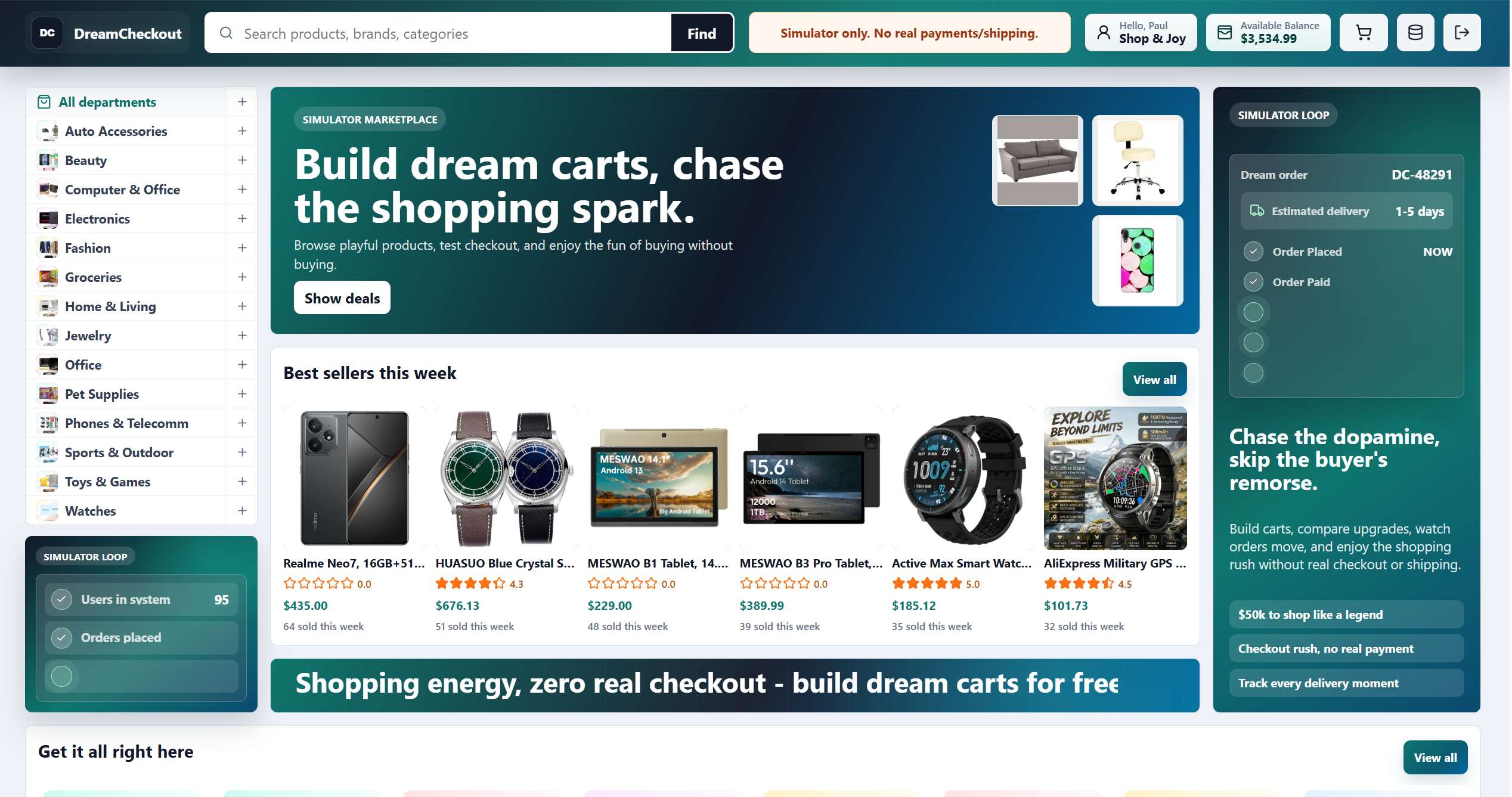
The catalog creates the first layer of a fake online shopping simulator: product discovery, categories, prices, ratings, visual browsing, and a clear simulator-only notice.
Filters and product grid
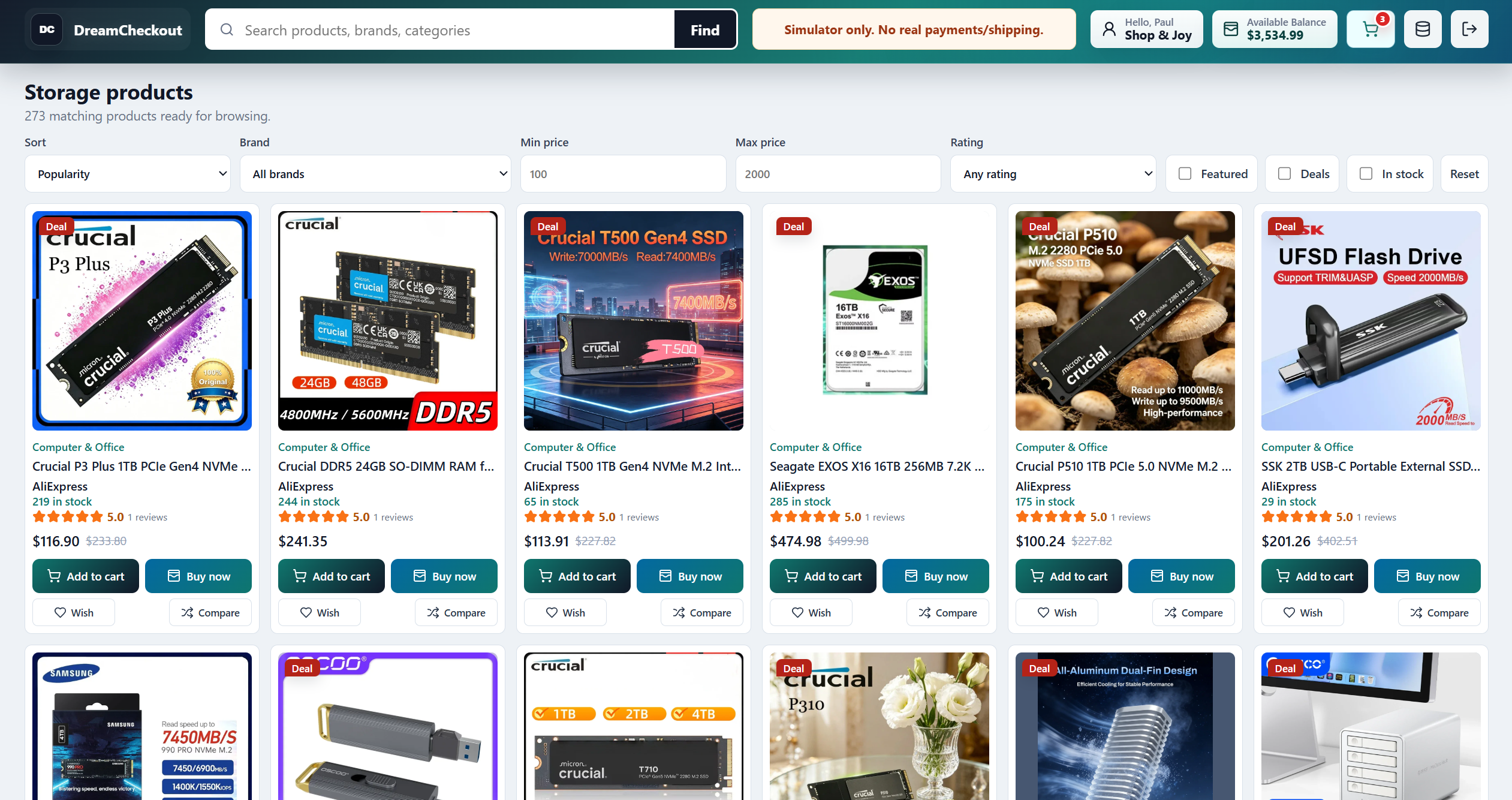
Sorting, brand filters, price ranges, rating filters, deals, stock, wishlist, compare, add-to-cart, and buy-now buttons make the fake store feel like a real ecommerce surface.
Healthy friction
The best dopamine loop includes a pause before real money moves
Real ecommerce often removes friction because fewer pauses usually mean more purchases. A simulator can do the opposite. It can preserve the fun parts while adding a handrail: this is virtual, this is fake checkout, this is not a shipping promise, this is a moment to observe the urge.
That friction is not punishment. It is the place where choice returns. When the user sees a product, likes it, carts it, and finishes a simulated order, the emotional loop gets an ending. Then the user can step away. If the desire survives tomorrow, it can be moved into a real budget. If it fades, the simulator absorbed the impulse at low cost.
This is why DreamCheckout should feel polished rather than clinical. A boring tool does not satisfy the shopping impulse. A deceptive tool is unsafe. The right middle is a realistic interface with repeated, plain simulator boundaries.

Stress, desire, and delayed spending
Composite consumer psychologist
The useful moment is the gap between wanting and paying. A simulator can widen that gap without shaming the desire.
Generated composite portrait. This is not a real person or a quoted clinician.- Shopping urges often carry emotional information, not only product intent.
- A cart makes the urge visible enough to inspect.
- A simulator is a pause tool, not therapy or medical advice.
Emotional signal
The product you want may be less important than the feeling it promises
A dopamine shopping session can reveal emotional patterns. A user who keeps adding blankets, lamps, and headphones may be seeking calm. A user who keeps adding watches, shoes, and jackets may be seeking confidence. A user who keeps adding storage bins, tools, and office products may be seeking control. None of these motives are wrong. They are information.
DreamCheckout turns that information into something visible. The cart is not just a list of products. It is a snapshot of what looked rewarding in that moment. If the same theme repeats across sessions, the user can ask a better question: do I need the item, or do I need the condition the item represents?
Sometimes the answer is still a real purchase. A good chair, coat, tool, or gift can improve life. But the simulator helps separate stable needs from temporary spikes, which makes real buying slower and more respectful of the user.
Interface proof
Cart, checkout, and account evidence
Cart and checkout path
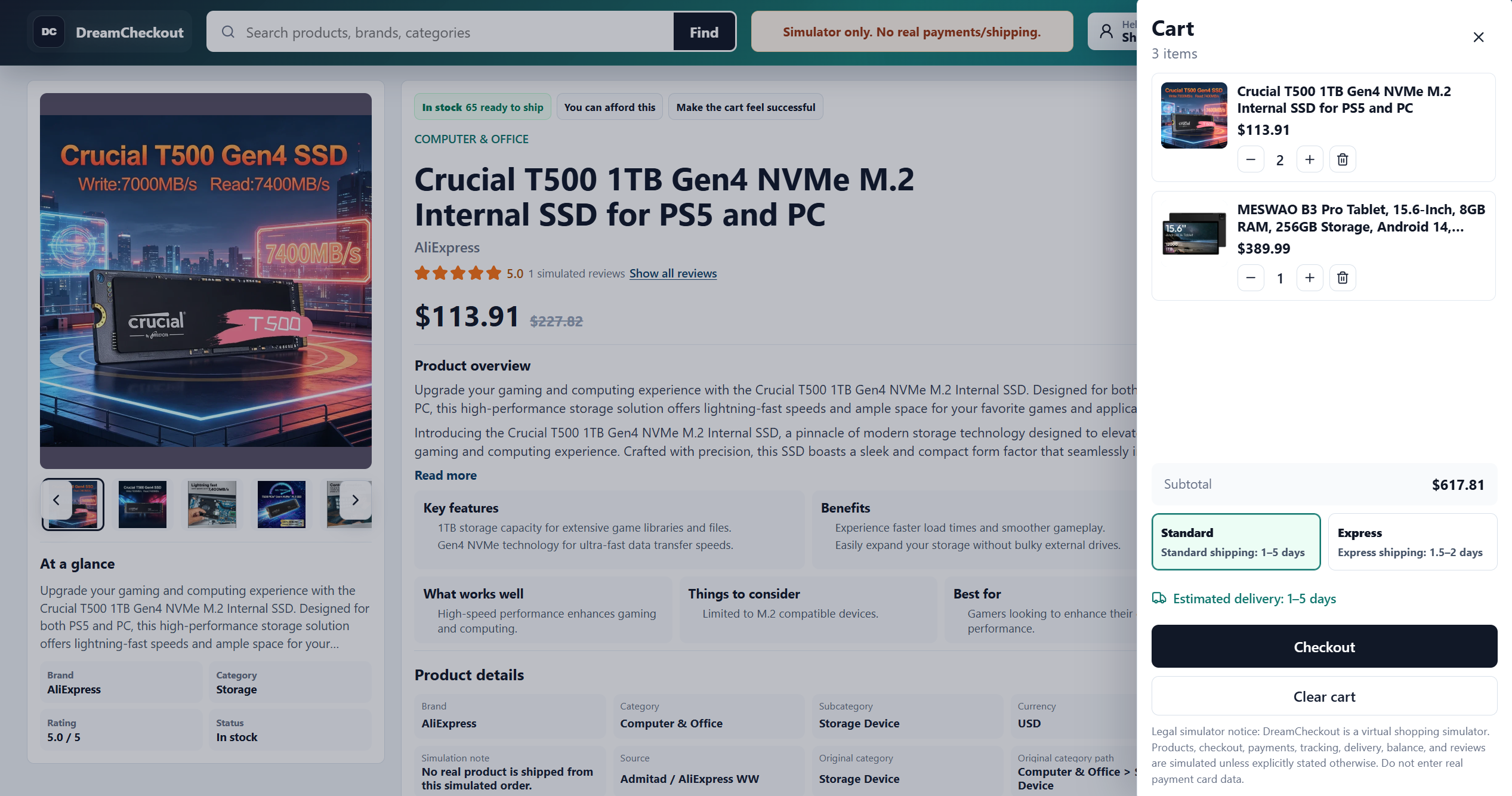
The cart drawer turns browsing into a visible list, shows subtotal and shipping choices, and gives the user checkout-shaped closure without a real payment card.
Account and virtual balance
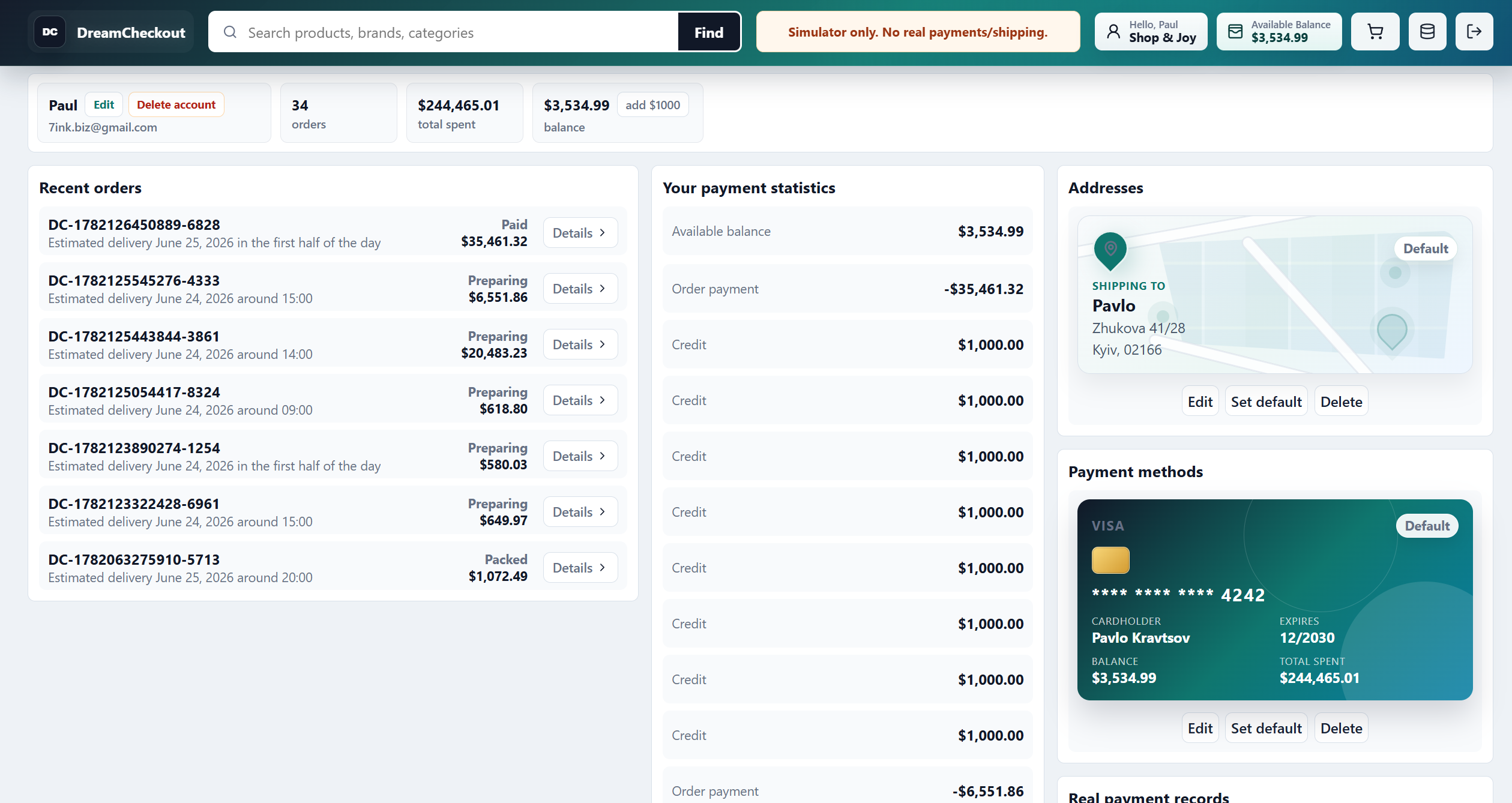
The account area makes the simulator feel complete: recent orders, payment statistics, virtual balance, saved address, and a fake payment method remain inside the no-real-transaction frame.
How to use it
Use the dopamine spark as a short ritual, not an endless scroll
A healthy dopamine shopping session should have a container. Pick one mood, one category, or one cart story. Browse for a few minutes. Add the products that pull attention. Complete the simulated checkout if closure would help. Then stop and name what the cart was trying to give you.
The name matters. "I want comfort." "I want a win." "I want to feel put together." "I want my space to stop feeling chaotic." Once the feeling has language, the user has more options than buying. They might clean one surface, make tea, plan a real budget line, take a walk, message a friend, or leave the fantasy as enough.
The simulator works best when it leaves the user lighter, not more restless. If the session makes the urge stronger, that is also useful information. Step away. The tool is meant to support choice, not replace it.
Limits
DreamCheckout can support a pause, but it is not therapy or medical advice
Some people use shopping to cope with stress, boredom, sadness, loneliness, or anxiety. A simulator can help create friction and awareness, but it cannot diagnose, treat, or cure compulsive shopping. If spending causes debt, secrecy, conflict, distress, or a loss of control, professional support matters.
DreamCheckout should be understood as a practical digital ritual: a place to browse, cart, and simulate checkout before real money moves. It can make a moment safer. It can reveal patterns. It can help delay a decision. It should not be treated as a complete solution to serious financial or mental health problems.
That honesty is part of the design. The platform can be playful and useful precisely because it does not pretend to be more than it is: a shopping simulator with a clear boundary.
Interface proof
Cart, checkout, and account evidence
Tracking interface
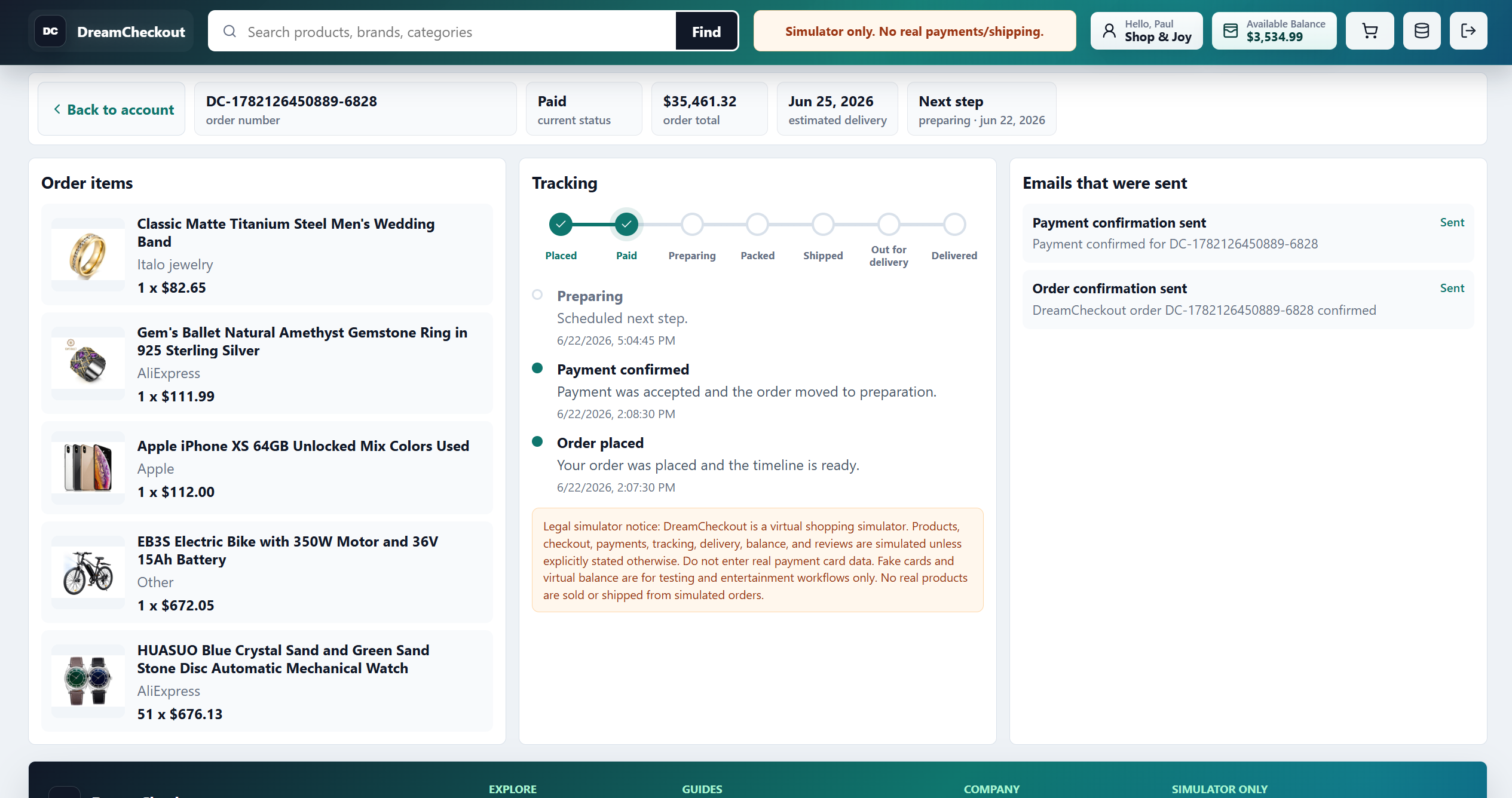
The tracking interface completes the simulated order story with item lists, status steps, email events, and an explicit legal simulator notice.
Order confirmation email
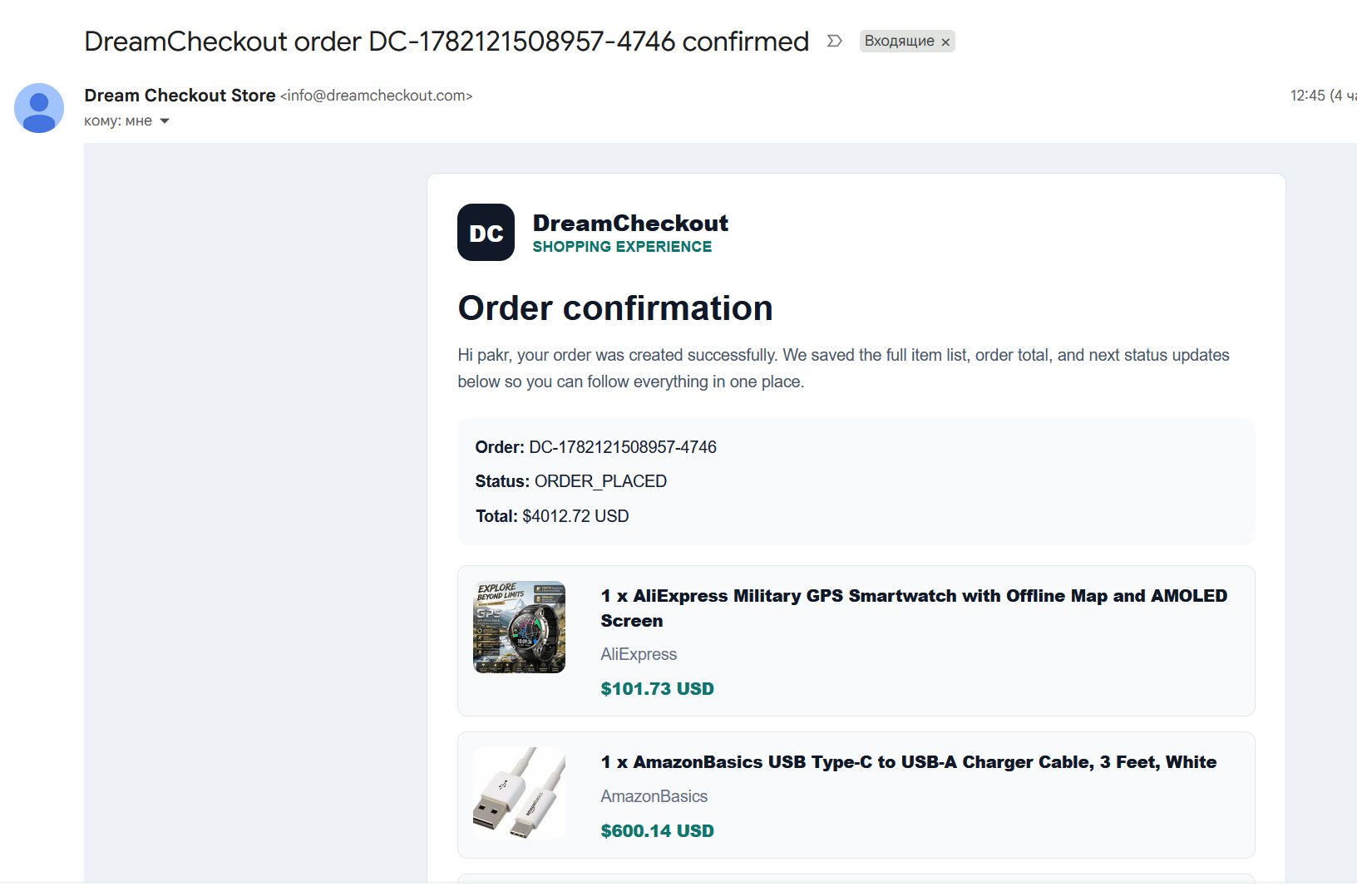
The order confirmation email extends the fake shopping loop beyond the browser with a receipt-like structure, item cards, order status, and branded simulator identity.
Interface proof
Where the dopamine loop appears inside DreamCheckout
The dopamine loop starts in the catalog. Images, categories, prices, ratings, and product names create possibility. The user is not only looking at objects; they are looking at possible improvements to a day, room, outfit, desk, routine, or mood. That is why the first screenshot matters: it shows the spark before checkout.
The filters screen adds control to the spark. Sorting by popularity, narrowing by price, selecting brand and rating, and toggling deals or in-stock items all create small decisions. Each decision makes the user feel more active. In a stress-shopping moment, that activity can feel like relief.
The cart drawer creates commitment without real cost. The user sees selected items, quantity controls, subtotal, shipping options, and a checkout button. In real retail, this is where the dopamine loop becomes payment. In DreamCheckout, the loop remains simulated and visibly marked as no-real-payment.
The tracking screen and confirmation email add closure. Dopamine shopping is not only the moment of adding to cart. It is the full story: choose, order, confirm, track, remember. DreamCheckout can complete that story without real shipment, which is why it fits the dopamine-shopping search intent better than a simple product gallery.

Why ecommerce signals feel rewarding
Composite retail strategist
Product grids, cart badges, checkout steps, and tracking timelines are progress signals. DreamCheckout keeps the signals while removing real payment.
Generated composite portrait. This is not a real person or a quoted retail executive.- Discovery, filtering, carting, checkout, and tracking create the shopping ritual.
- Realistic UX has to be paired with explicit simulator boundaries.
- The best no-spend experience feels familiar but never deceptive.
Expert perspective
Why psychologists and retail experts read the dopamine loop differently
A psychologist would focus on anticipation and emotion regulation. The product is not always the main reward. Sometimes the reward is imagining change, seeing progress, and creating a small moment of control. A simulator can be useful when it lets that anticipation happen without immediately rewarding spending.
A retail strategist would focus on the learned language of ecommerce. Users know that cart badges, stock labels, ratings, discounts, checkout buttons, and delivery timelines mean progress. DreamCheckout borrows those signals while removing the real transaction. The result is familiar enough to feel satisfying and clear enough to stay safe.
An ecommerce lifecycle expert would focus on the post-checkout layer. Confirmation emails, tracking pages, and abandoned-cart reminders are powerful because they extend the shopping story over time. In a simulator, those same tools can create closure and reflection rather than pressure to spend.
These views support the same practical rule: dopamine shopping works best when the session is short, labeled, and finite. The goal is to feel the spark, read the cart, complete the fake loop if useful, and step away before the spark becomes another automatic real purchase.
Dopamine examples
Different carts reveal different reward promises
A novelty cart is full of surprising gadgets, unusual products, colorful items, or things the user has never considered before. The reward promise is stimulation. The healthy question is whether the novelty still matters tomorrow or whether it was only a temporary need for freshness.
A comfort cart is full of soft, warm, cozy, calming products. The reward promise is relief. The healthy question is whether a product is needed or whether the body is asking for rest, food, quiet, warmth, or a break from screens.
A status cart is full of watches, shoes, accessories, phones, or premium-looking items. The reward promise is confidence or recognition. The healthy question is whether the purchase supports a stable self-image or only covers a short insecurity.
A control cart is full of organizers, tools, storage, cleaning products, desk gear, or productivity items. The reward promise is order. The healthy question is whether the first step is buying tools or doing one small organizing action now.
Final note
A dopamine shopping site should satisfy the spark without hiding the boundary
The best dopamine shopping site is not the one that maximizes stimulation forever. It is the one that gives the spark a safe arc. DreamCheckout should feel rich enough to make browsing enjoyable, but structured enough that the session has an ending.
That ending is the difference between a useful ritual and another craving loop. The user can browse, filter, add to cart, fake-checkout, see tracking, receive an email, and then stop. If the desire remains later, it can become a real decision. If it fades, the simulator did its job.
That is the strongest promise for this page: dopamine without deception, shopping energy without automatic spending, and a clear pause before real money moves.
Mechanics
Why the dopamine spark feels strongest before checkout
The strongest spark often appears when the outcome is still imagined. Before checkout, the product can be perfect. It has not arrived, disappointed, created clutter, required assembly, or forced a return. The mind can hold the ideal version. That ideal version is a major part of the reward.
Product pages support that ideal version with images, benefits, prices, ratings, and social proof. Filters and recommendations keep the search alive. The cart makes the imagined future feel closer. Checkout makes the future feel chosen. A dopamine shopping site works because it keeps those signals visible while removing the real-world cost.
DreamCheckout should therefore avoid becoming flat or clinical. If the interface is too dull, it will not satisfy the shopping spark. But it should also avoid becoming manipulative. The best version has enough realism to create anticipation and enough clarity to remind the user that the order is simulated.
The practical takeaway is that dopamine shopping should be treated as a short ritual. The user can enjoy the spark, build the cart, complete the fake loop if useful, and then leave. The spark becomes information rather than a command.

Email, tracking, and cart recovery loops
Composite ecommerce lifecycle expert
The post-checkout layer is where shopping becomes a story. In a simulator, that story can create closure without a parcel.
Generated composite portrait. This is not a real person or a quoted product leader.- Confirmation emails make the simulated order memorable.
- Tracking pages turn a fake decision into a visible sequence.
- Abandoned-cart reminders should invite reflection, not pressure.
Safeguards
How a dopamine shopping site should protect users from confusion
The first safeguard is visible simulator language. The user should see that checkout is fake, payment is virtual, tracking is generated, and delivery is not real. This should appear before checkout, during checkout, after checkout, and in email contexts.
The second safeguard is a healthy session design. DreamCheckout should make it easy to complete a loop rather than scroll forever. A cart, tracking page, and confirmation email can act as end points. The user should know when the ritual is done.
The third safeguard is honest claims. A dopamine shopping site can support stress relief, impulse cooling, entertainment, and reflection. It should not claim to treat addiction, anxiety, depression, or financial distress. Strong boundaries make the product more trustworthy.
The fourth safeguard is internal education. Related pages about shopping without spending, online window shopping, fake checkout, and stopping impulse buying help users choose the healthiest frame for their own intent.
Real-life playbook
Four simple ways to use it when the urge to buy appears
Use the spark as a short reset, not an endless product feed. Stop when the cart has a clear mood.
Ask whether the cart promises comfort, status, control, beauty, escape, preparedness, or novelty.
Use simulated checkout for closure, then wait before turning any item into a real purchase.
A good session should feel lighter. If it creates more urgency, step away and use a grounding activity.