Put a fake cart between the urge and the real checkout button.
Stop impulse buying online
Stop impulse buying online by putting a fake cart before real checkout
Use DreamCheckout to stop impulse buying online with simulated carts, fake checkout, 24-hour delay, cart reflection, and safer boundaries before real spending.
Let the hot state cool before deciding what belongs in a real budget.
A cooled non-purchase is a win: no charge, no clutter, and better information.
The goal is not to never want things
The goal is to slow the moment between wanting and spending, so real purchases become more intentional. Desire is information, not an automatic order.
A fake checkout can close the loop
Instead of fighting the urge with pure willpower, DreamCheckout lets the user complete a harmless simulated order, get closure, and revisit the choice later.
Use support when the problem is bigger
DreamCheckout can be a helpful pause tool, but severe shopping addiction, debt, secrecy, or distress deserves qualified professional support.
A fake cart creates a deliberate step between the buying urge and the real checkout button.
Let the desire survive time before deciding whether it belongs in a real budget.
The goal is to understand the impulse, not punish yourself for wanting something.
When weak urges fade in the simulator, real purchases can become more intentional and useful.
Detailed explanation
How a fake checkout can help with real shopping pressure
DreamCheckout is not a store and not therapy. It is a structured simulator that gives the shopping impulse somewhere safer to go before it reaches a real card, a real package, or real regret.
The problem
Impulse buying online is fast because the path from want to payment is too short
Online stores are built to reduce friction. A product appears, the button is obvious, payment details may already be saved, and checkout can be finished before the user has fully understood the urge. That speed is convenient when the purchase is planned. It is dangerous when the purchase is emotional.
Stopping impulse buying online does not always mean banning shopping completely. For many people, a more realistic goal is to add a pause. The pause gives the hot state time to cool. It turns "I need this now" into "I can look at this first." DreamCheckout exists for that gap.
A fake cart is useful because it does not ask the user to do nothing. It gives the urge an action: browse, add, compare, simulate checkout, and revisit. The action feels shopping-like, but the money stays out of the moment.
Why willpower fails
A hard no can leave the loop open
Many impulse-control tips say to simply avoid buying. That can work, but it often leaves the emotional loop unfinished. The user saw the cue, imagined the reward, and prepared for closure. If the only answer is no, the urge can keep buzzing in the background.
DreamCheckout offers a different kind of friction. It lets the user complete a simulated version of the loop. The confirmation, tracking, and review structure can provide enough closure for the urge to soften. Afterward, the user can decide from a calmer place.
This is not magic and not medical treatment. It is practical design. A safer substitute behavior is often easier to repeat than pure resistance.
Interface proof
A fake cart before the real checkout button
DreamCheckout catalog
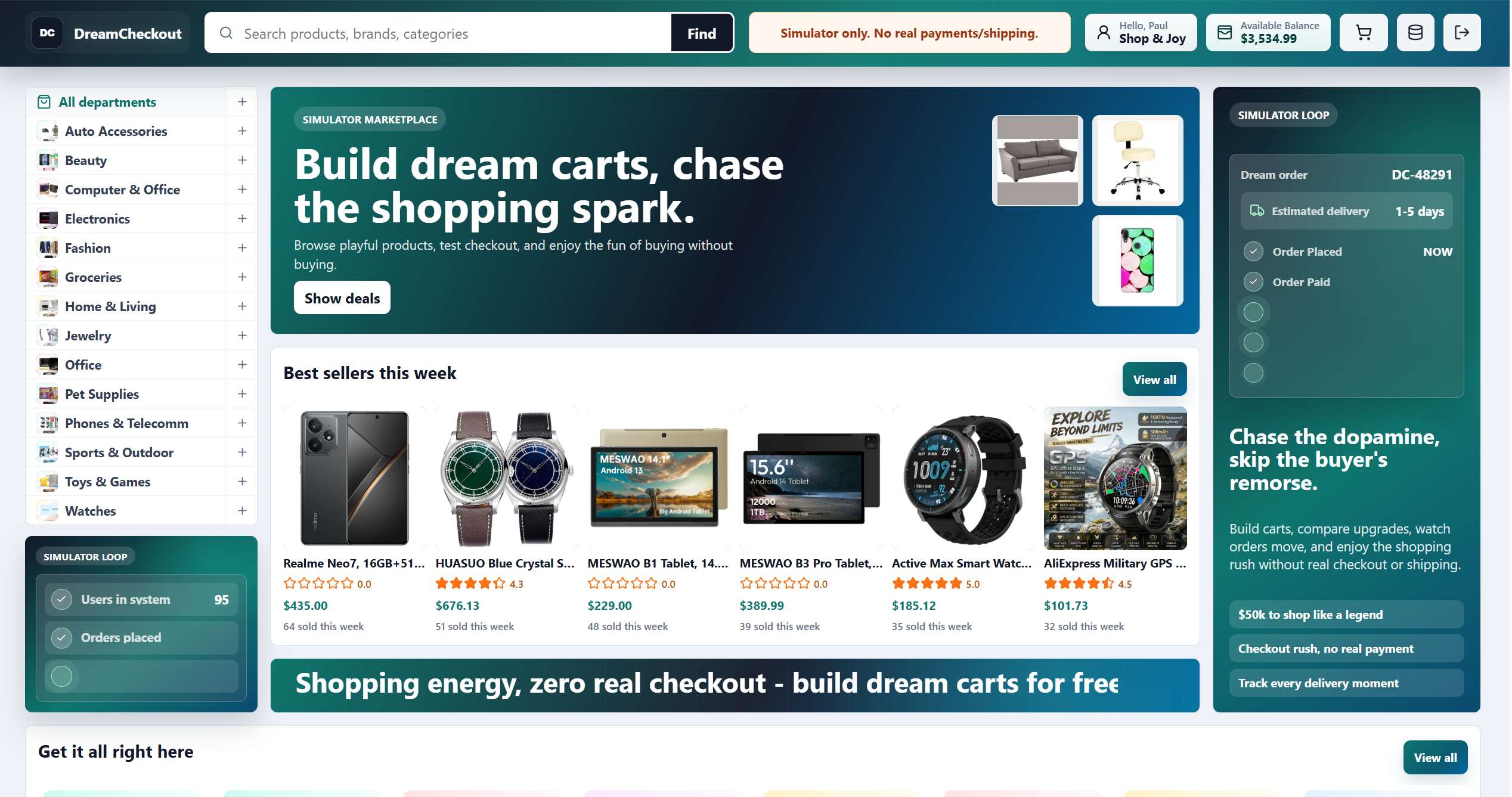
The catalog creates the first layer of a fake online shopping simulator: product discovery, categories, prices, ratings, visual browsing, and a clear simulator-only notice.
Filters and product grid
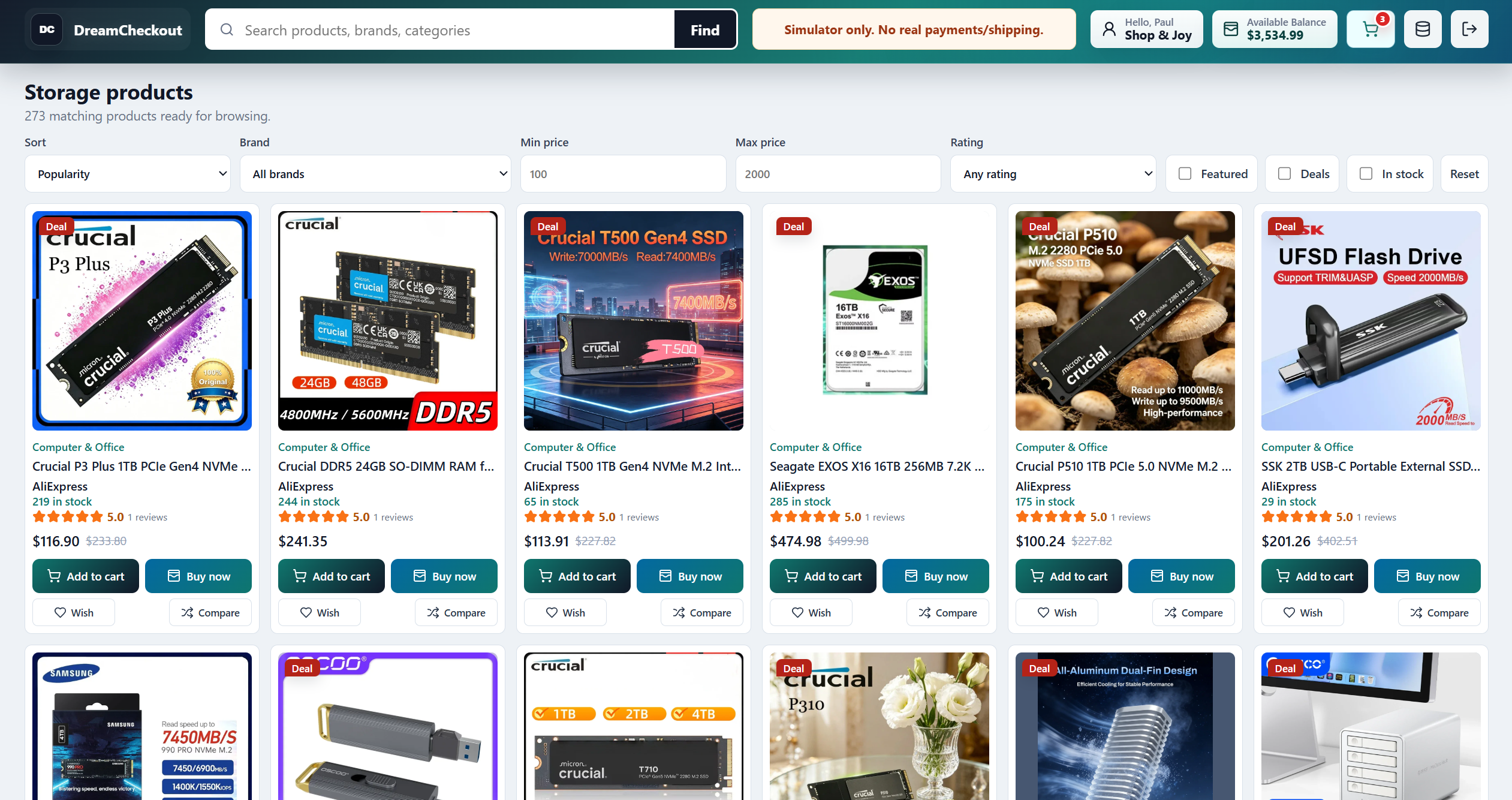
Sorting, brand filters, price ranges, rating filters, deals, stock, wishlist, compare, add-to-cart, and buy-now buttons make the fake store feel like a real ecommerce surface.
The fake cart method
Use the simulator as a holding area for wants
When the urge to buy appears, put the product category into DreamCheckout first. If you want shoes, build a shoe cart. If you want a gadget, build a gadget cart. If you want a comfort purchase, build a comfort cart. The cart becomes a holding area where the desire can exist without demanding payment.
Then read the cart. Is it practical, emotional, status-driven, boredom-driven, or stress-driven? Does it solve a repeated problem? Would it still matter if nobody saw it? Would you buy it at full price? Would you want it tomorrow? These questions become easier after the desire is visible.
If the item survives the fake cart, the delay, and the questions, it may deserve a real plan. If it does not, the simulator protected the user from a weak purchase.

Stress, desire, and delayed spending
Composite consumer psychologist
The useful moment is the gap between wanting and paying. A simulator can widen that gap without shaming the desire.
Generated composite portrait. This is not a real person or a quoted clinician.- Shopping urges often carry emotional information, not only product intent.
- A cart makes the urge visible enough to inspect.
- A simulator is a pause tool, not therapy or medical advice.
Real routines
The 24-hour and 72-hour rules become easier when the urge has somewhere to go
Waiting rules are useful but hard. "Wait 24 hours" sounds simple until the product feels urgent. DreamCheckout makes waiting more realistic by giving the user a satisfying action during the waiting period. Complete the fake checkout today, then decide tomorrow.
For larger purchases, use 72 hours. If the item still feels useful after three days, compare it with real budget priorities. If it no longer matters, do not treat that as failure. Treat it as proof that the impulse was temporary and the pause worked.
The point is not to make every purchase difficult. The point is to make unplanned emotional purchases slower than planned useful purchases.
Interface proof
Cart, checkout, and account evidence
Cart and checkout path
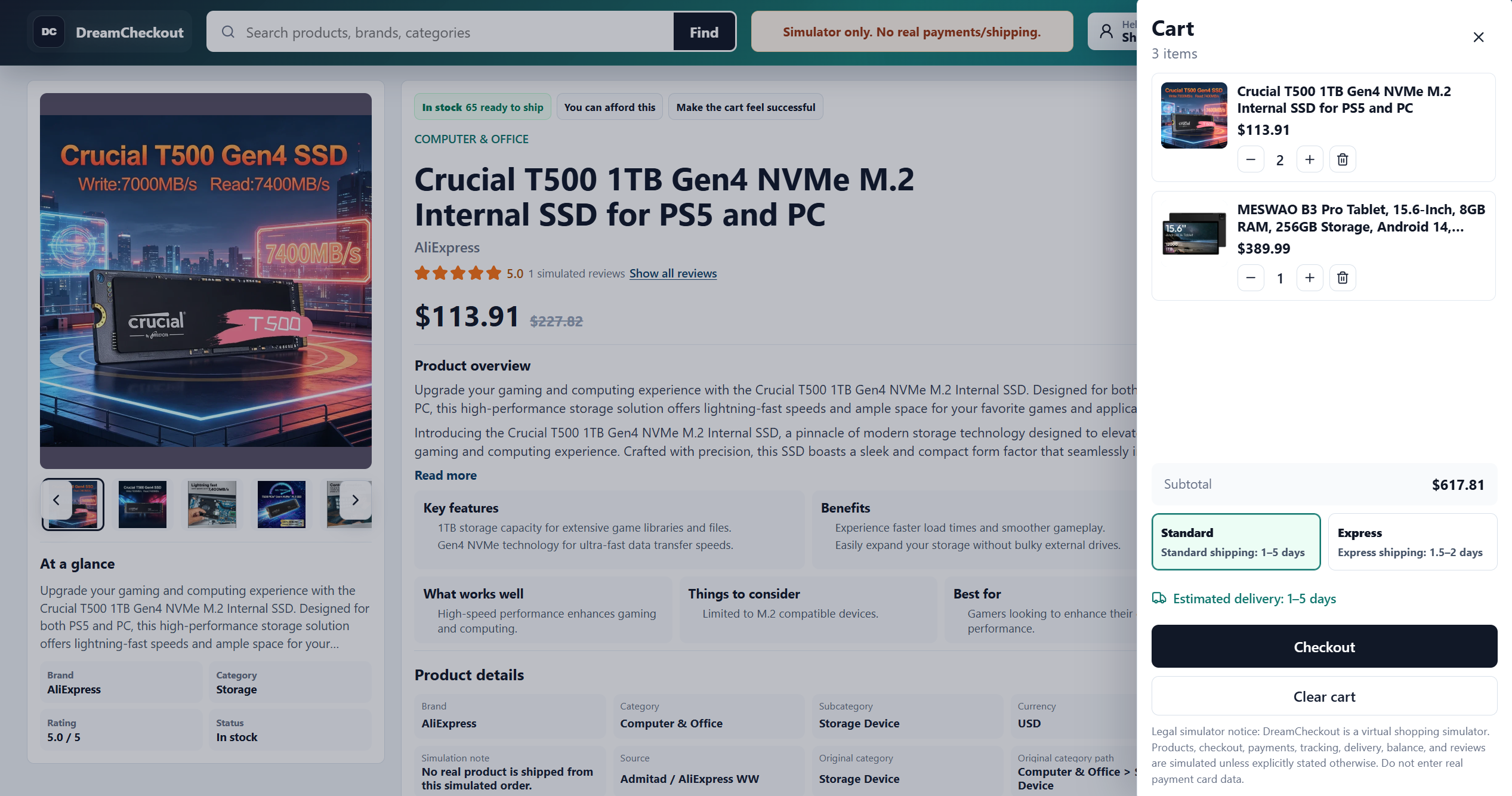
The cart drawer turns browsing into a visible list, shows subtotal and shipping choices, and gives the user checkout-shaped closure without a real payment card.
Account and virtual balance
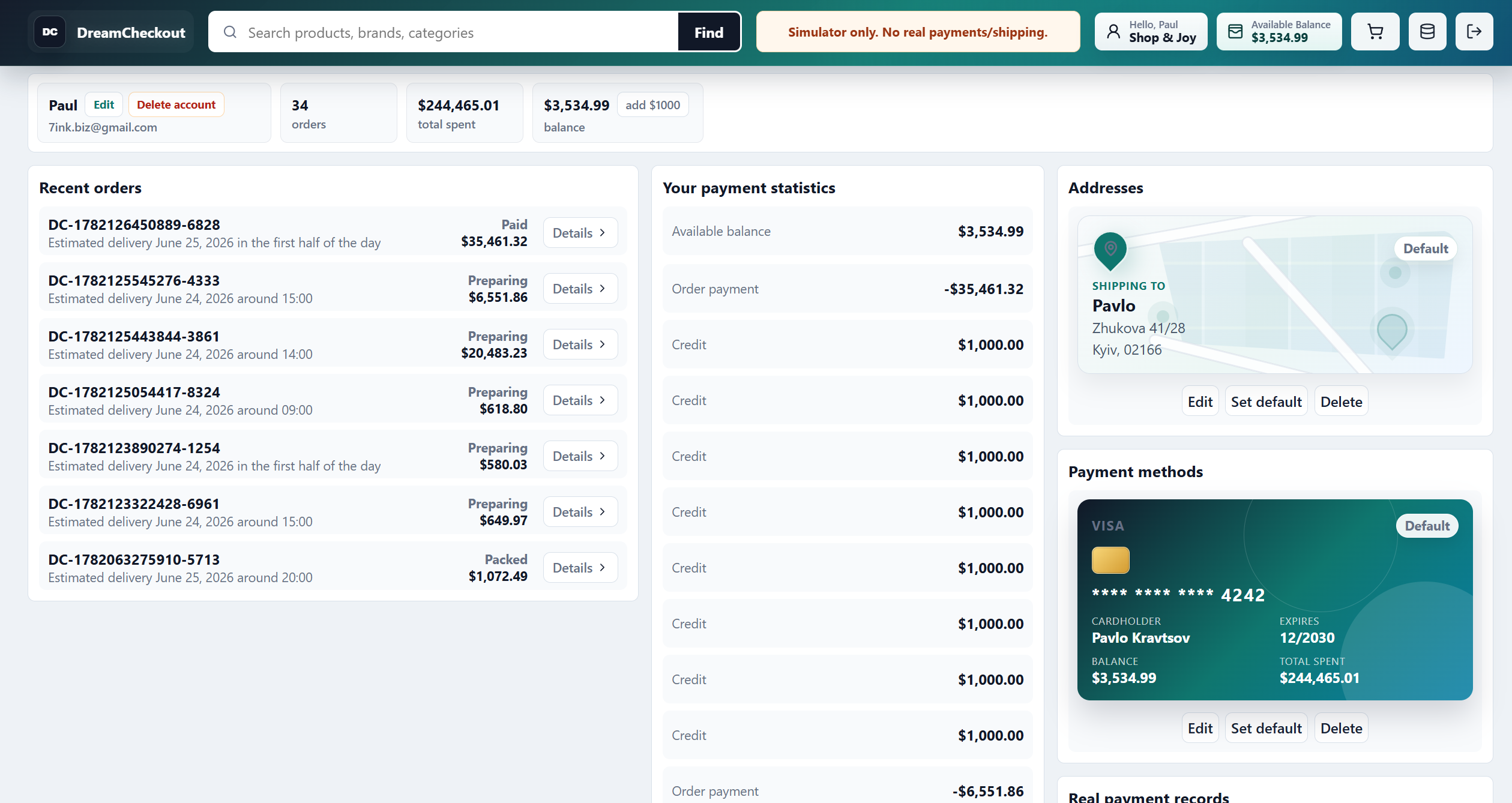
The account area makes the simulator feel complete: recent orders, payment statistics, virtual balance, saved address, and a fake payment method remain inside the no-real-transaction frame.
Emotional triggers
Impulse buying often points to a non-product need
A person may buy because they are tired, lonely, bored, overstimulated, under-rewarded, anxious, or trying to feel like a better version of themselves. The product is real, but the emotional job may be bigger than the object. That is why buying can feel good briefly and then disappoint.
A simulator can reveal the emotional job. A cart full of cozy products may be asking for rest. A cart full of expensive accessories may be asking for recognition. A cart full of organizing tools may be asking for control. Once the need is named, the user can choose from more options than checkout.
Sometimes the right answer is still a purchase. Often it is sleep, food, movement, cleaning one small area, talking to someone, planning a real budget, or letting the feeling pass.
Support
When impulse buying is serious, get help beyond a simulator
DreamCheckout can support a pause, but it is not therapy, financial counseling, or medical advice. If shopping leads to debt, secrecy, relationship conflict, distress, or repeated loss of control, a qualified professional, counselor, financial advisor, or trusted support person may be necessary.
The simulator is best understood as one small tool: a friction layer, a mirror, and a substitute ritual. It can help make the first pause easier. It cannot solve every reason a person shops impulsively.
Healthy use means leaving the session with more choice. If any digital shopping experience makes the urge stronger or harder to control, step away and use a more grounding support strategy.
Interface proof
Cart, checkout, and account evidence
Tracking interface
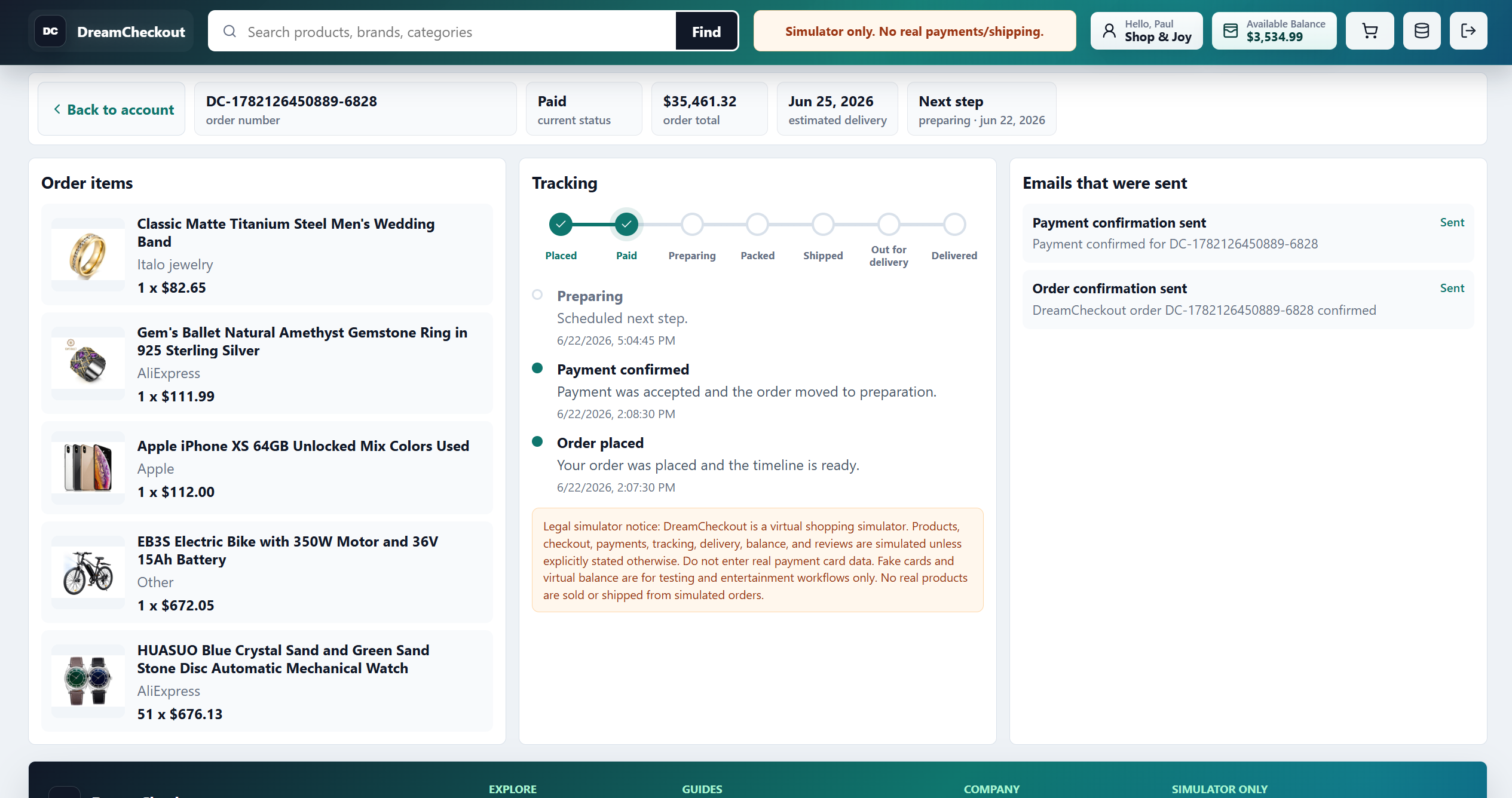
The tracking interface completes the simulated order story with item lists, status steps, email events, and an explicit legal simulator notice.
Order confirmation email
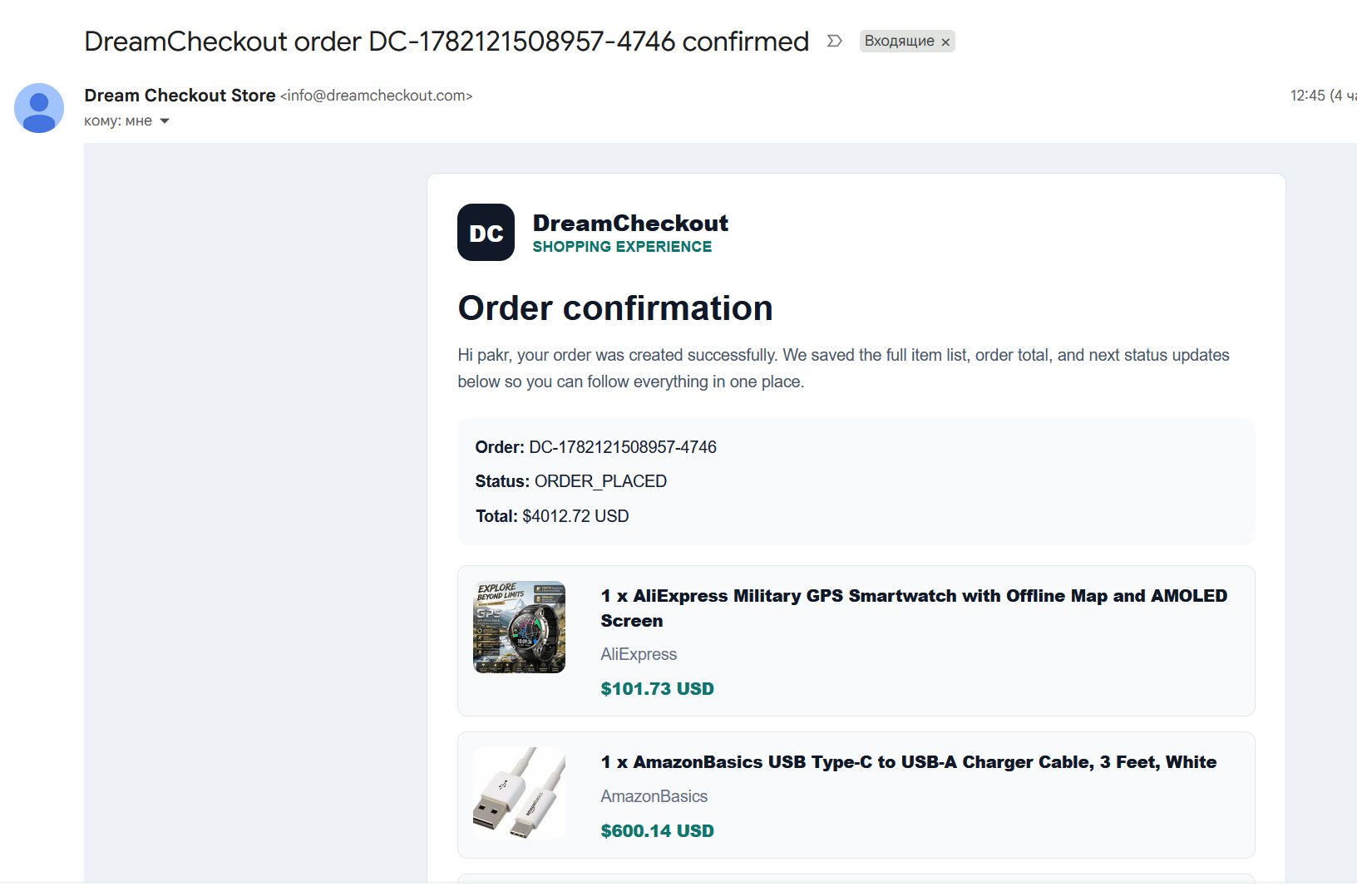
The order confirmation email extends the fake shopping loop beyond the browser with a receipt-like structure, item cards, order status, and branded simulator identity.
Screenshots
How the DreamCheckout screens create friction before real checkout
The catalog screenshot shows where the impulse begins: products, prices, ratings, and visual novelty. In a real store, this surface is designed to move the user toward payment. In DreamCheckout, the same surface becomes a safer first stop because the simulator boundary is visible from the beginning.
The filters screenshot adds a useful delay. Instead of buying the first item that sparks interest, the user can sort, narrow, compare, and notice what they are looking for. Filters turn the urge into a set of choices. That small friction can be enough for the hot state to cool.
The cart screenshot is the key intervention. It puts a fake cart between the urge and the real checkout button. The user sees items, quantities, subtotal, shipping choices, and the checkout-shaped ending, but no real card charge is required. This lets the buying impulse complete a harmless version of the loop.
The tracking and email screenshots extend the delay. A simulated order can feel closed without producing a parcel. A confirmation email can preserve the record of what the user wanted. Later, the user can ask whether the desire still feels meaningful or whether the fake order already satisfied the moment.

Why ecommerce signals feel rewarding
Composite retail strategist
Product grids, cart badges, checkout steps, and tracking timelines are progress signals. DreamCheckout keeps the signals while removing real payment.
Generated composite portrait. This is not a real person or a quoted retail executive.- Discovery, filtering, carting, checkout, and tracking create the shopping ritual.
- Realistic UX has to be paired with explicit simulator boundaries.
- The best no-spend experience feels familiar but never deceptive.
Expert perspective
Why experts focus on the space between urge and action
A psychologist would describe impulse buying as a short path from cue to reward. The cue may be stress, boredom, comparison, fatigue, or a product image. The action is checkout. The reward is relief, novelty, control, or identity. DreamCheckout adds an extra step between cue and action.
That extra step matters because emotions are time-sensitive. A purchase that feels necessary at 11:30 PM may feel irrelevant the next morning. A fake cart gives the urge somewhere to go while time does some of the cooling work.
A retail strategist would point out that real ecommerce removes pauses on purpose. Saved payment details, sticky buttons, stock warnings, and personalized recommendations all shorten the path. A simulator can reverse that logic. It keeps the familiar surface but turns it into a deliberate pause.
An ecommerce lifecycle expert would focus on what happens after the fake order. Tracking and email should not push the user into real buying. They should help close the simulated story and invite reflection. The best message is not buy now; it is notice what you wanted.
Questions
Questions to ask after the fake cart is built
The first question is: what feeling does this cart promise? If the answer is comfort, confidence, control, beauty, escape, or reward, the user has already learned something useful. The product may not be the only way to answer that feeling.
The second question is: would I still want this tomorrow at full price? Discounts and urgency can distort attention. A fake cart removes the immediate pressure, so the user can ask whether the item has value outside the sale moment.
The third question is: does this solve a repeated problem? A product that solves a repeated problem may deserve a real plan. A product that only answers a passing mood may belong in the simulator and nowhere else.
The fourth question is: what would I do if I could not buy this? The answer may reveal a non-shopping solution: rest, cleaning one area, messaging someone, going outside, planning a budget, cooking, moving, or simply waiting.
The fifth question is: what happens if I do nothing for 24 hours? If the answer is nothing serious, the urge probably does not need immediate payment. That is the kind of clarity the fake cart is meant to create.
Scenarios
Common impulse moments and how the fake cart changes them
Late-night shopping is one of the clearest examples. The user is tired, decision-making is weaker, and a product feels like a reward. DreamCheckout can absorb the ritual: browse, cart, fake-checkout, and sleep before any real purchase decision.
Stress shopping after work is another example. The user wants a clean win after a messy day. A fake cart can provide the sense of action without turning the workday into a bill. The next morning, the user can decide whether any item still matters.
Sale-driven shopping is a third example. The discount creates urgency, even when the product was not important before the sale. In DreamCheckout, the user can place similar products into a simulated cart and ask whether the item is still desirable without the countdown.
Identity shopping is a fourth example. The user wants to feel more organized, stylish, successful, calm, or prepared. A fake cart can show the identity being pursued. Then the user can decide whether buying is the best path or whether one real habit would do more.
Final note
Stopping impulse buying means adding choice, not removing desire
The goal is not to become a person who never wants anything. Desire is normal. Product interest is normal. Enjoying shopping is normal. The problem is when the path from desire to payment is too short for choice to return.
DreamCheckout adds a visible pause. It lets the user do the shopping-shaped action without creating a real order. The cart becomes evidence. The fake checkout becomes closure. The tracking becomes a fictional ending. Then real money can wait.
That makes the page’s promise practical: use the simulator before the store, read the cart before the purchase, wait before the payment, and treat every cooled urge as a successful non-purchase.

Email, tracking, and cart recovery loops
Composite ecommerce lifecycle expert
The post-checkout layer is where shopping becomes a story. In a simulator, that story can create closure without a parcel.
Generated composite portrait. This is not a real person or a quoted product leader.- Confirmation emails make the simulated order memorable.
- Tracking pages turn a fake decision into a visible sequence.
- Abandoned-cart reminders should invite reflection, not pressure.
Emergency routine
A five-minute routine when the urge feels urgent
Minute one: name the trigger. Say the plain sentence: I am tired, bored, stressed, lonely, jealous, excited, or looking for a reward. Naming the trigger does not remove the urge, but it stops the product from pretending to be the whole story.
Minute two: open DreamCheckout instead of a real store. Search the same product category, but keep the action inside the simulator. This redirects the shopping motion without putting real payment details in reach.
Minute three: add only three products. The limit matters. A huge cart can become another spiral. Three products are enough to show the pattern while keeping the session readable.
Minute four: read the cart. Ask what the products promise: rest, control, confidence, novelty, escape, beauty, status, preparedness, or comfort. The answer is often more useful than the items.
Minute five: close the loop without real payment. Either leave the cart, complete fake checkout, or write one note for tomorrow. The goal is to get through the hot moment without creating a real charge.
Relapse prevention
How to make the pause repeatable
A pause tool works best when it is ready before the urge arrives. Bookmark DreamCheckout, decide when to use it, and set a rule: before any unplanned online purchase, build the same kind of cart in the simulator first. This turns the fake cart into a default step.
Use a waiting period based on purchase size. Small items can wait 24 hours. Larger items can wait 72 hours. Expensive items can wait until the next budget review. The simulator gives the urge something to do during that waiting period.
Track repeated categories. If the same category appears again and again, it may deserve a real plan. Maybe the user needs one planned clothing budget, one home organization project, or one comfort purchase with a limit. Repetition is data.
Celebrate cooled urges. A non-purchase is not failure. It is a result: no charge, no clutter, no return, no hidden package, and better information about what the user actually wanted.
Ask for help when the pattern is bigger than a pause. If shopping causes debt, secrecy, panic, conflict, or repeated loss of control, DreamCheckout should be only one small tool inside a larger support plan.
Real-life playbook
Four simple ways to use it when the urge to buy appears
Before opening a real checkout, build the same kind of cart in DreamCheckout and finish the fake loop first.
Will I use it this week? Would I buy it tomorrow? Does it solve a repeated problem? Is it in budget? What feeling does it promise?
Small wants wait one day. Larger wants wait three. If the desire survives, make a real plan instead of an impulse buy.
When an urge fades, count it as a win: no charge, no clutter, no return, and better information about yourself.