The current wave was reported across international outlets in June 2026.
South Korea dopamine shopping boom
South Korea dopamine shopping boom: why fake checkout sites went viral
A news-style guide to South Korea dopamine shopping sites: fake carts, simulated checkout, stress-shopping relief, specialist context, and a basic use routine.
Users browse, cart, order, and track while no real payment or delivery happens.
The main promise is a shopping-like dopamine spark without buyer remorse.
A new name for an old shopping habit
People have always browsed, wishlisted, and filled carts without buying. The Korean dopamine-site boom turns that quiet behavior into an intentional product category.
Sources describe a no-payment shopping ritual
Times of India, The Week, and AS/MeriStation all point to the same idea: the cart itself can be rewarding before ownership begins.
DreamCheckout fits the trend with clearer boundaries
DreamCheckout gives users a rich fake shopping loop while repeating that no real sale, shipment, refund, warranty, or delivery obligation is created.
Several outlets reported that South Korean Gen Z users are testing dopamine sites for shopping-like relief without real payment.
The viral format keeps catalogs, carts, checkout, receipts, and tracking while removing the real charge and delivery.
The trend fits a wider digital habit: people want a small sense of control, novelty, and completion during stressful moments.
The useful version is transparent. It should feel like shopping, but it must not pretend that a real product is coming.
Source snapshots
What the news coverage says
These are editorial summaries of the sources we reviewed. The page names publications for context, but does not send readers away with external article links.
- Viral shopping-like platforms
- Carts and tracking without charges
- Stress relief and mixed user reactions
- Browse products
- Click order
- No real purchase
- Replicated ecommerce flows
- No money spent
- Gen Z adoption in South Korea
Basic use scheme
From stress cue to fake checkout pause
The user wants a quick reset or a tiny sense of control.
Images, categories, prices, and reviews create anticipation.
Desire becomes visible as a list instead of a vague urge.
The loop closes without a bank charge or parcel obligation.
The user can ask what the cart was really trying to solve.
Detailed explanation
How a fake checkout can help with real shopping pressure
DreamCheckout is not a store and not therapy. It is a structured simulator that gives the shopping impulse somewhere safer to go before it reaches a real card, a real package, or real regret.
News brief
South Korea turned fake shopping into a viral dopamine ritual
A fresh wave of news coverage in June 2026 described a new South Korean habit: young users visiting ecommerce-like websites that let them browse products, add items to a cart, complete a pretend order, and even follow simulated delivery states without spending real money. Times of India framed the story around Gen Z users seeking the thrill of shopping without a charge. The Week treated the idea as visible enough to become a public naming contest. AS/MeriStation described the same pattern as virtual dopamine: a fake store that copies the emotional arc of ecommerce without the financial consequence.
The interesting part is not that people like shopping. That has always been true. The new part is that the shopping interface itself has become the product. The catalog, the cart, the checkout button, the receipt, and the tracking timeline can be satisfying even when no item arrives. The Korean boom makes that hidden truth easy to see: many people are not only buying objects; they are buying a short story about choice, control, future self, and completion.
DreamCheckout was built for exactly that boundary. It gives the user a rich marketplace surface, but keeps the simulator label visible. That makes it different from a scam store and different from a normal retailer. The purpose is not to sell goods. The purpose is to let a person experience the shopping loop, notice what they want, and leave the session without a surprise charge, package, return, or regret.
What people say
The public reaction is split between relief, humor, and doubt
The reports describe a range of reactions. Supporters say that fake shopping can feel like a harmless substitute for retail therapy. A late-night craving, a stressful commute, or a bored scroll can become a short simulated order instead of a real purchase. Some users say the ritual gives them the feeling that they completed something, even though they know nothing will be delivered.
Skeptics make a fair point too. For some people, a fake order may feel frustrating because the reward is too imaginary. For others, it might even sharpen the desire to buy for real. That is why the experience needs a clear container. It works best as a conscious pause: use it for a few minutes, build one cart, complete the fake loop if closure helps, then stop. If a user keeps chasing a stronger feeling, the simulator is no longer serving its best purpose.
The most useful takeaway is practical. A dopamine site is not magic and not treatment. It is a substitution surface. It lets the brain do part of the shopping sequence while the wallet stays out of the hot moment. That can be enough to cool many ordinary impulses, especially when the user returns later and asks whether the product still matters.
Interface proof
News sources and DreamCheckout interface evidence
Times of India source
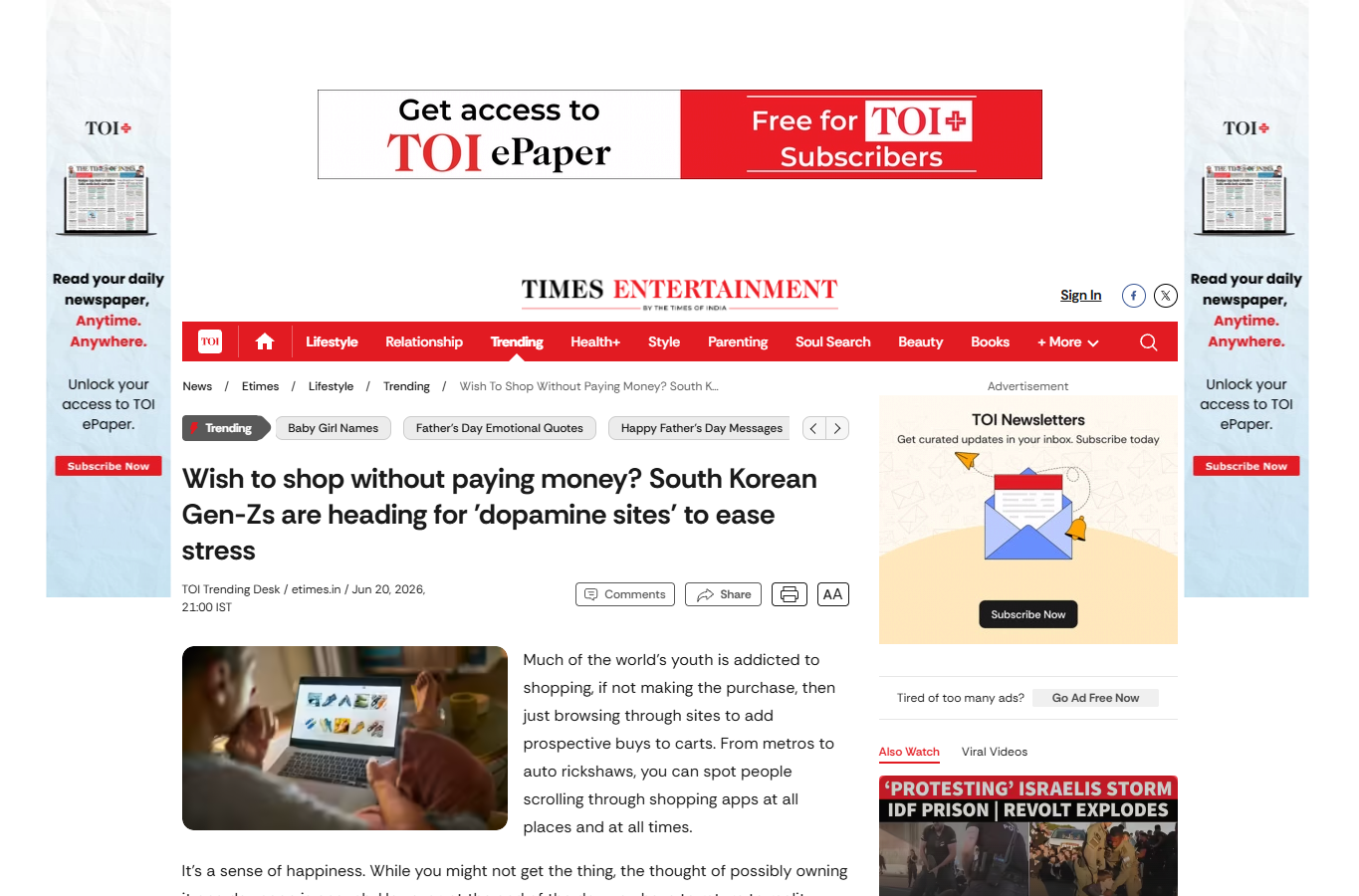
Times of India framed the story around South Korean Gen Z users visiting dopamine sites to get the shopping thrill without paying real money.
The Week source
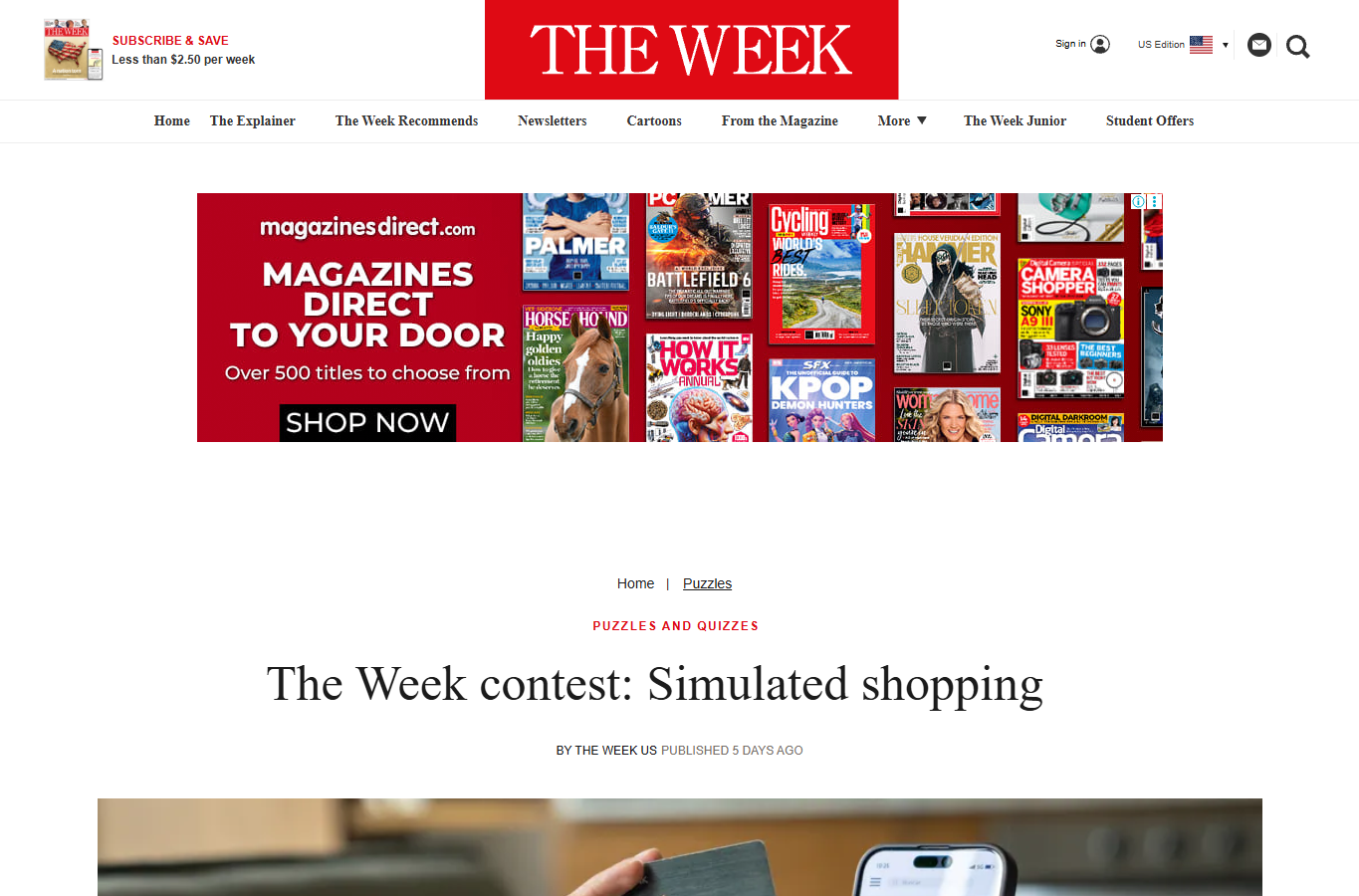
The Week treated simulated shopping as visible enough to become a mainstream cultural prompt, which shows the topic has moved beyond a small niche.
Specialist view
Why the cart can feel rewarding before anything is owned
Consumer psychology specialists often explain online shopping through anticipation rather than ownership. The reward starts when a product becomes imaginable: the user sees a cleaner room, a sharper outfit, a better desk, a calmer evening, or a more upgraded version of daily life. Times of India also pointed to clinical commentary about anticipation being a large part of the pleasure.
A behavioral specialist would not treat dopamine sites as a cure for compulsive buying. The stronger and safer claim is narrower: a transparent simulator can add friction between desire and payment. It can turn an automatic purchase into a visible cart, a completed pretend loop, and a later decision. That pause gives the prefrontal, more reflective part of decision-making time to return.
The best design principle is honesty. The page should not hide the fake nature of the transaction. A user should never wonder whether a real order exists. When the boundary is visible, the simulator can become a helpful ritual: enjoyable enough to satisfy the shopping itch, clear enough to avoid deception, and structured enough to teach the user something about their own wants.

Stress, anticipation, and impulse cooling
Composite clinical psychologist
The useful part is not the fantasy of ownership. The useful part is the pause between cue and payment. A simulated cart can make the urge visible enough for reflection to return.
Generated composite portrait. This is not a real person or a quoted clinician.- Stress narrows attention toward fast relief, which is why a clean shopping loop can feel calming.
- Anticipation can reward the brain before ownership begins, especially when progress is visible.
- A simulator should be finite and honest; it is a friction tool, not therapy.
How to use it
A basic scheme for a healthy dopamine shopping session
Start with one mood. Do not open a simulator as an endless scroll. Open it with a sentence: I want calm, I want control, I want novelty, I want to feel prepared, or I want a small reward. That sentence changes the session from autopilot into observation.
Next, build one cart. Choose three to seven items that match the mood. Avoid optimizing forever. The cart should become a snapshot, not a trap. Look for the pattern: are the items about comfort, status, order, beauty, health, confidence, or escape?
Then complete the fake checkout only if closure helps. After the pretend order, leave the page and revisit the cart later. If the desire survives a day, it may deserve a real budgeted decision elsewhere. If it disappears, the simulator already did something valuable: it gave the impulse a safe ending.
Interface proof
Cart, checkout, and account evidence
AS MeriStation source
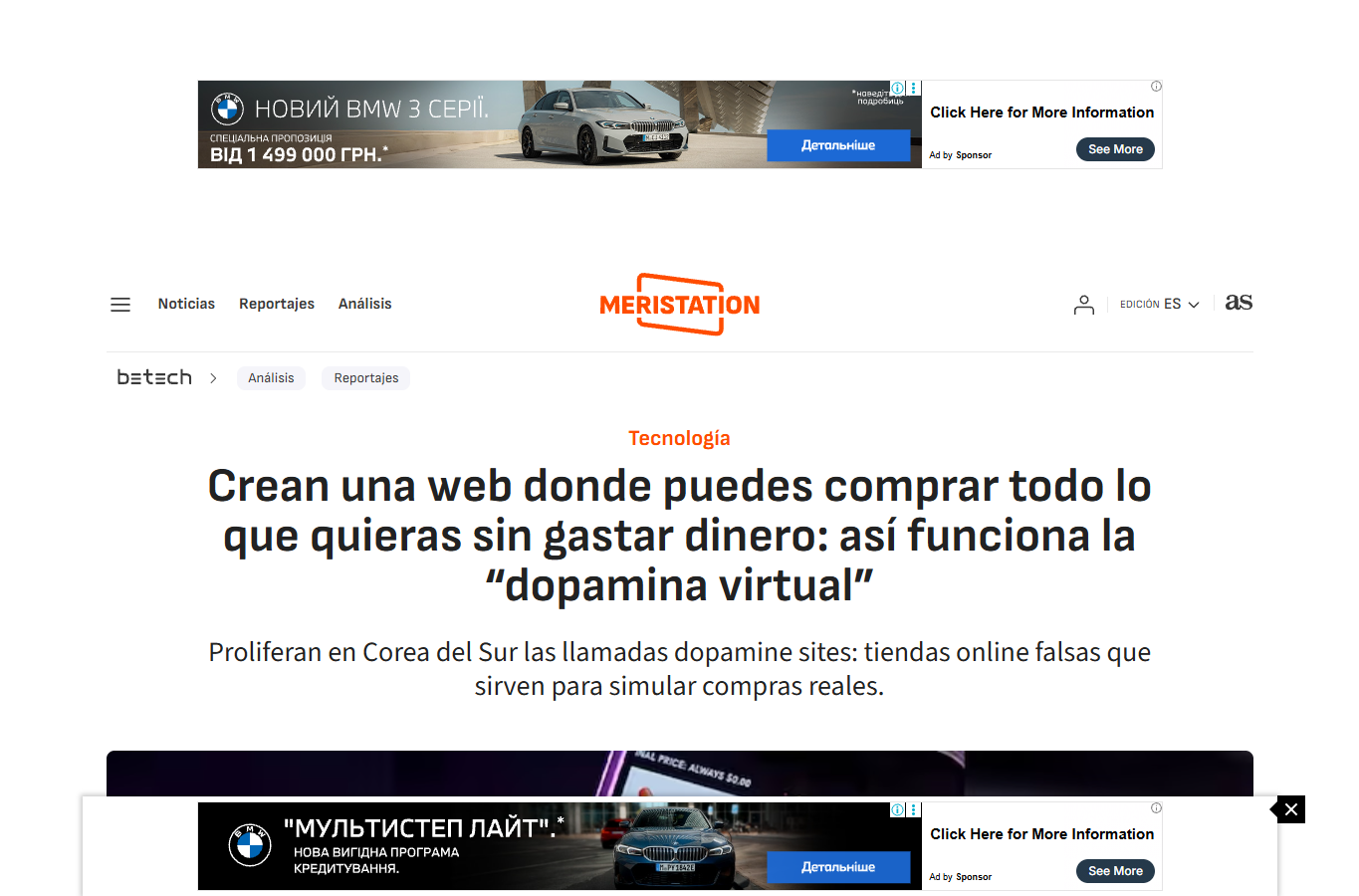
AS / MeriStation described the trend as virtual dopamine and highlighted false online stores that simulate real purchases in South Korea.
DreamCheckout catalog
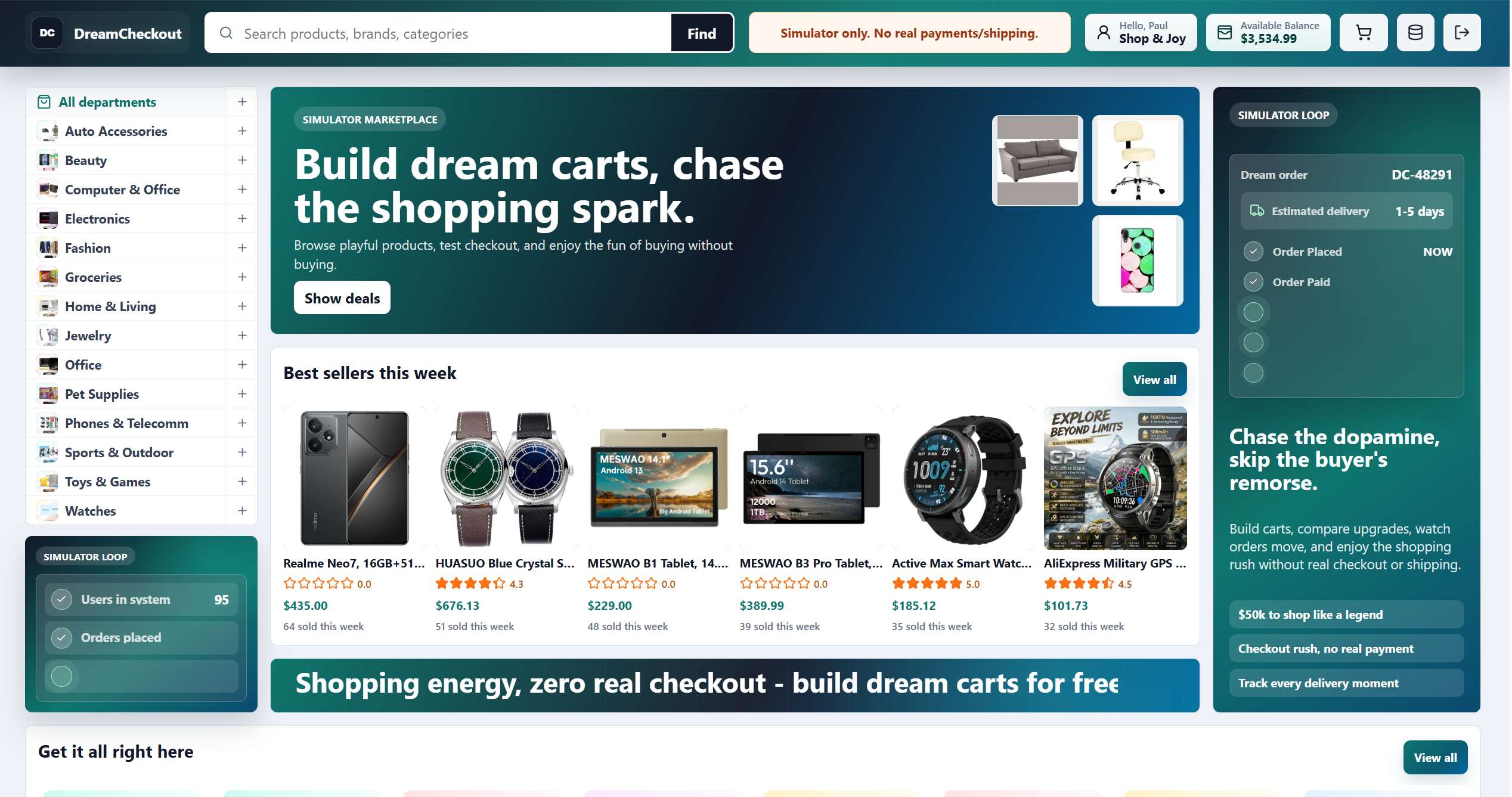
DreamCheckout shows the same emotional architecture the news coverage describes: product discovery, dream carts, fake order progress, and an explicit no-payment boundary.
DreamCheckout angle
Why the Korean boom matters for DreamCheckout
The South Korean trend gives language to a behavior that already existed globally. People have been filling carts, saving wishlists, tracking prices, and abandoning checkout for years. Dopamine sites simply make the hidden motive explicit: sometimes the user wants the shopping feeling more than the product.
DreamCheckout can serve that intent with more structure than a random fake store. It includes product discovery, wishlists, comparison, cart, virtual balance, checkout, order states, account history, and internal guide pages. That makes it suitable for playful browsing, impulse cooling, ecommerce UX testing, and mood-based reflection.
The opportunity is to meet the search demand while staying responsible. The page can say: yes, the dopamine hit is real; yes, the trend is becoming visible; yes, you can enjoy a shopping-like loop here; and no, this is not a real sale, medical promise, or replacement for professional help when shopping feels out of control.
Root cause
Stress is the first engine behind dopamine shopping
Stress often creates a desire for a smaller world that can be controlled. A difficult day has vague problems: too many messages, too many decisions, not enough money, not enough rest, social comparison, work pressure, loneliness, or the feeling that nothing is moving. A shopping interface is the opposite. It is sorted, searchable, priced, pictured, rated, filtered, and responsive. Every click does something. Every filter narrows the world. Every product card offers a possible answer.
That is why shopping can feel calming before anything is purchased. The user is not only looking at objects. The user is practicing agency. Search is agency. Sorting is agency. Adding to a cart is agency. Choosing shipping is agency. Even a fake checkout can feel like a small completed task. When the nervous system is overloaded, a clean sequence of visible actions can feel like relief.
A dopamine shopping simulator redirects that need for control into a lower-risk environment. Instead of opening a real retailer with saved cards, one-click checkout, real shipping, real returns, and real regret, the user opens a fake checkout loop. The urge still gets an action. The catalog still gives novelty. The cart still creates shape. The checkout still creates closure. But the real wallet is not pulled into the hot moment.
This is the responsible way to explain the Korean boom. It is not that young users suddenly became irrational. It is that normal ecommerce already trained people to use shopping as a mood tool. The dopamine-site trend removes the purchase from that mood tool and exposes the underlying ritual. The ritual is: I feel pressure, I browse, I choose, I organize desire, I complete a small loop, I feel a little shift.
The useful version has a limit. If a simulator becomes endless scrolling, it can reproduce the same overstimulation as real shopping apps. If it is used as one short session, it can create a pause. DreamCheckout should be framed as that pause: a place to let the shopping impulse move through a clear fake loop before real payment becomes available anywhere else.
Interface proof
Cart, checkout, and account evidence
DreamCheckout filters
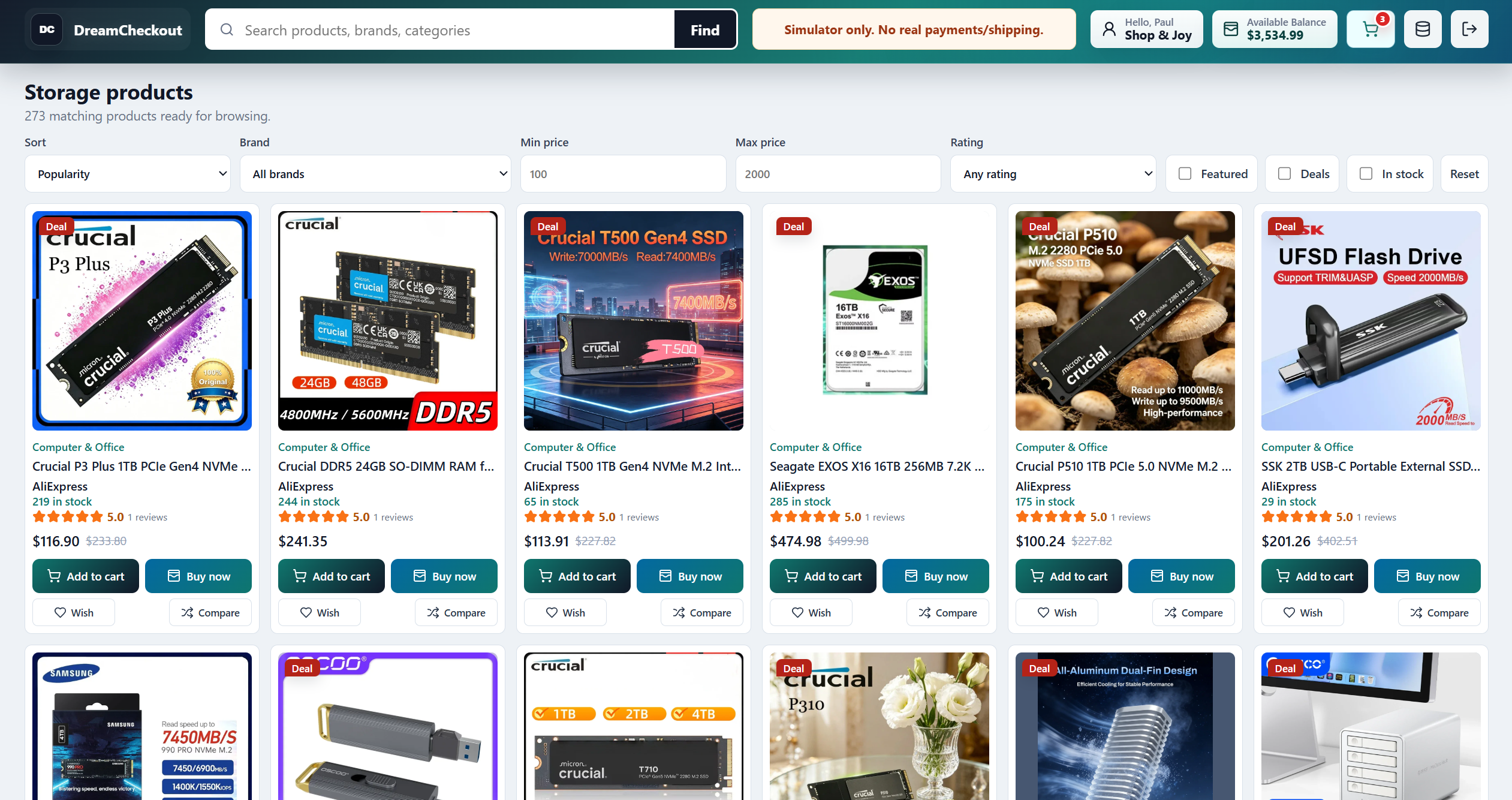
Filters, sorting, ratings, stock, compare, wishlist, add-to-cart, and buy-now controls make the simulator feel like a real store while still staying inside the fake checkout frame.
Cart and checkout path
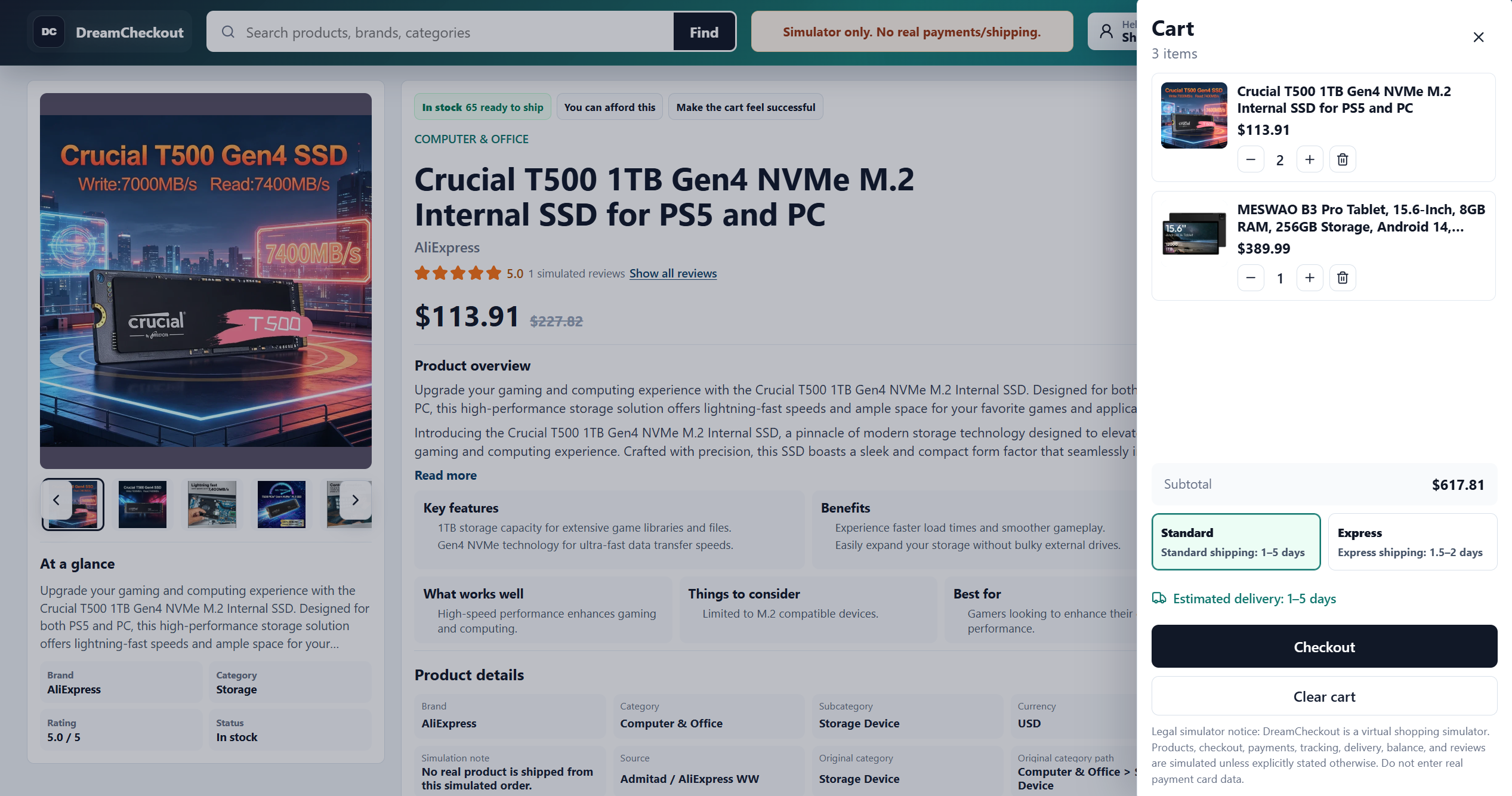
The cart drawer turns the urge into a visible list, exposes subtotal and delivery choices, and gives the user a checkout-shaped ending without a real card charge.
Dopamine
Anticipation is stronger than ownership in many shopping moments
The word dopamine is often used loosely, but the practical idea is simple: anticipation can be rewarding before ownership begins. A product card is not just a product card. It is a possible better room, better desk, better outfit, better routine, better body, better trip, better version of the day. A watch can mean competence. A lamp can mean calm. A storage box can mean control. A snack can mean comfort. A gadget can mean play or escape.
Online retail is built to make those possible futures vivid. Product images make the object concrete. Ratings make it safer. Reviews make it social. Discounts make it urgent. Stock labels make it scarce. Recommendations make the search feel personalized. The cart makes the desire visible. Checkout makes the desire feel decided. Tracking turns the decision into a story that continues after the user leaves the page.
This is why fake checkout can work even when the user knows nothing will arrive. The simulator preserves the anticipation structure. It lets the user discover, compare, save, cart, order, and track. The brain still sees progress signals. The user still feels the little forward motion of a decision. Ownership is absent, but the sequence is present.
That distinction is crucial for SEO and product positioning. A dopamine shopping site is not merely a shopping game and not merely a wishlist. A wishlist stores desire, but it usually leaves the loop unfinished. A game may be playful, but it may not speak the language of real ecommerce. A fake checkout simulator sits between them. It uses real ecommerce grammar while keeping the consequence fictional.
DreamCheckout has to make anticipation feel complete without making it deceptive. That means the site needs dense catalog pages, filters, product detail pages, cart states, order statuses, emails, and tracking. It also needs repeated plain-language boundaries: simulator only, no real payment, no shipping, no retail obligation. The richer the anticipation becomes, the more important the boundary becomes.

Why the store interface became the product
Composite retail strategist
Retail has trained people to read the cart, discount, stock badge, and delivery promise as progress. Dopamine sites keep the progress signals and remove the transaction.
Generated composite portrait. This is not a real person or a quoted retail executive.- Modern commerce sells a sequence: discover, compare, choose, checkout, track, receive, review.
- Fake checkout sites work because the sequence itself has become emotionally legible.
- The strongest products will be transparent about simulation while still feeling rich enough to satisfy browsing intent.
Retail design
Retail interfaces trained users to read cart and tracking signals as progress
Modern ecommerce has created a shared visual language. Users know what a cart badge means. They know what a checkout button means. They know what order placed means. They know what payment confirmed means. They know what preparing, packed, shipped, out for delivery, and delivered mean. These labels are not just operational states; they are emotional states. They tell the user that the desire has moved forward.
Retail teams understand this very well. The store does not end at the product page. The experience continues through cart, payment, confirmation, email, shipping updates, delivery, review prompts, and retention offers. Each step gives the user another reason to remember the purchase and feel that a story is unfolding. A dopamine shopping simulator borrows the same lifecycle but removes fulfillment.
That is why screenshots are essential on this page. The trend sounds abstract until the reader sees the mechanics. The DreamCheckout catalog shows aspiration. The filters show control. The cart drawer shows visible commitment without payment. The tracking screen shows closure. The order email shows that the simulator can continue the story outside the browser. The news-source screenshots show that this is not invented from thin air; international publications are already describing the behavior.
A retail strategist would say that the interface became the product because ecommerce made the interface emotionally fluent. People know how to feel their way through it. A fake store does not need to teach the user what to do. The user already knows. That familiarity is powerful, which is why responsible simulation has to be explicit rather than vague.
DreamCheckout should use retail design as an educational surface. The same patterns that can push real conversion can also teach self-observation when the financial endpoint is removed. Add to cart becomes: what did I want? Checkout becomes: did closure help? Tracking becomes: did the story satisfy the urge? Email becomes: did the desire return later or fade?
Interface proof
Tracking and email evidence
Tracking interface
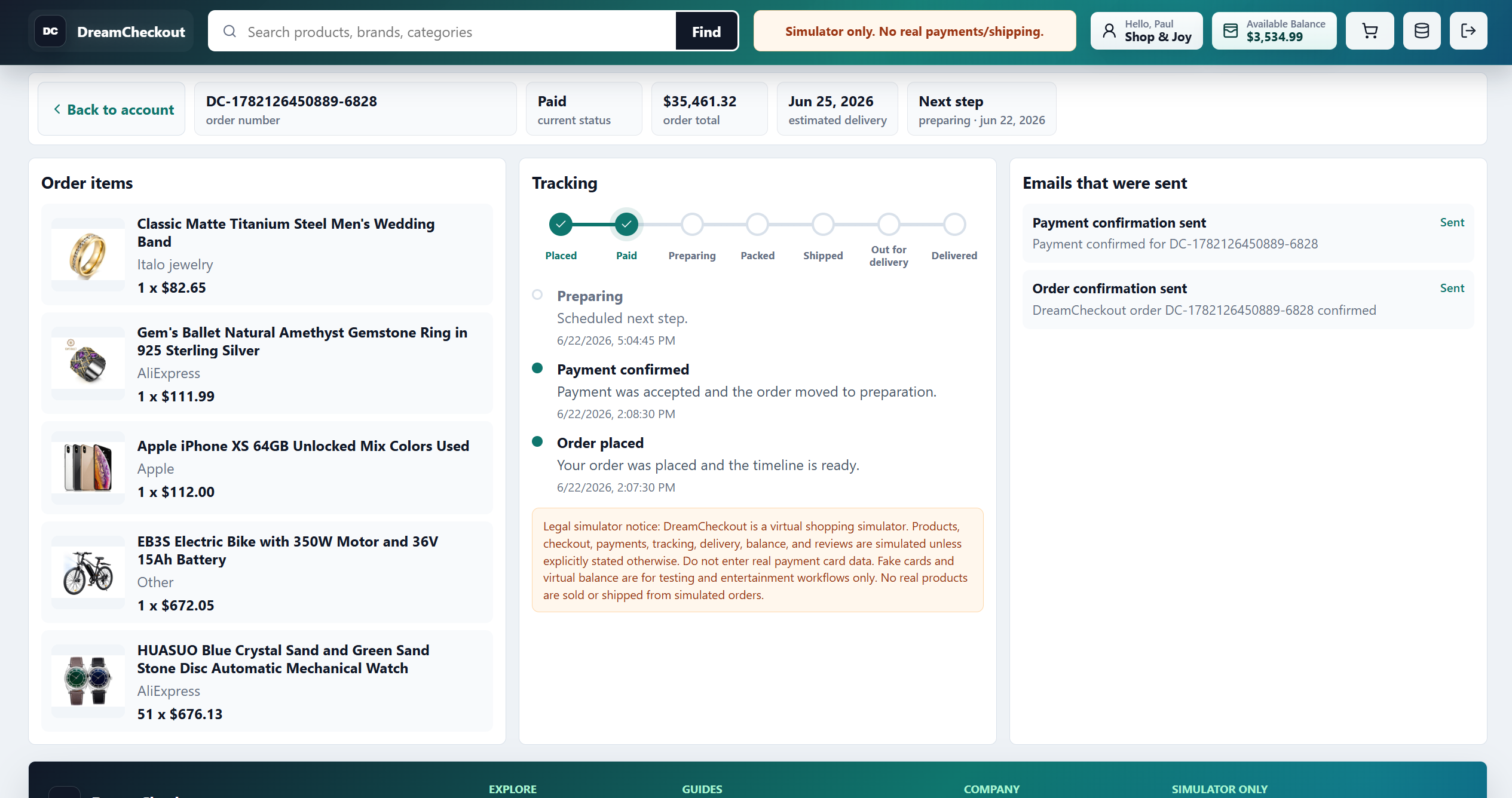
The tracking interface completes the pretend order story with item lists, status steps, email events, and a simulator notice that keeps the boundary explicit.
Order confirmation email
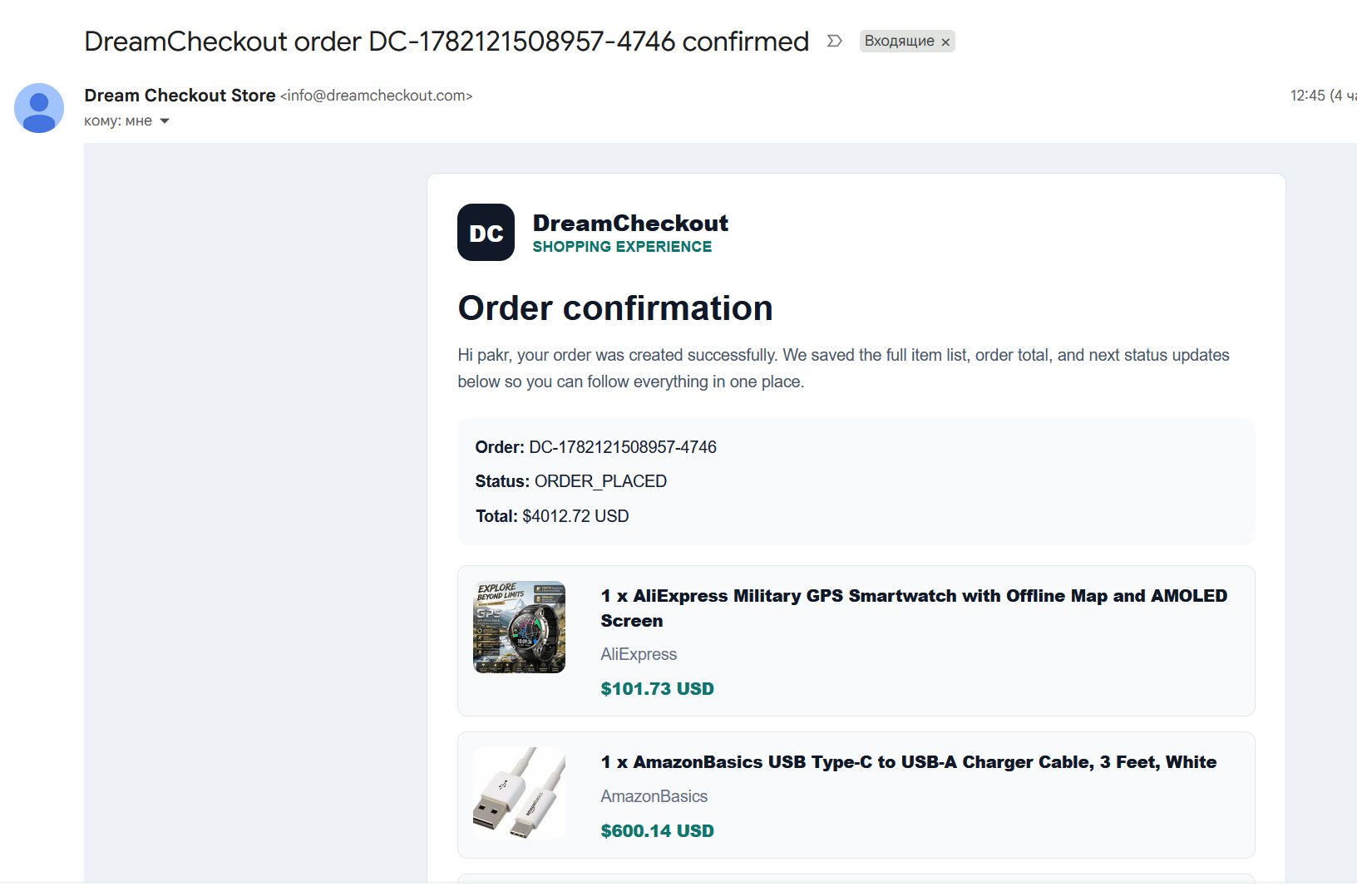
The order confirmation email extends the dopamine loop outside the page: order number, status, total, item cards, and a branded receipt-like structure.
Psychology view
A psychologist would call this a pause tool, not therapy
A psychology-informed reading should start with compassion. People do not impulse shop because they are stupid. They often shop because a feeling needs somewhere to go. Stress, boredom, fatigue, low mood, anxiety, social comparison, and the desire for control can all push attention toward fast rewards. Shopping is attractive because it offers visible action, fantasy, and a quick sense of completion.
A simulator can help when it increases the space between cue and payment. The cue is the feeling: I want something, I need a lift, I need control, I need novelty. The old action might be opening a real store and buying. The simulator inserts another action: open a fake store, build a cart, complete a pretend loop, and wait. That delay can give reflective thinking time to return.
The cart is especially useful because it makes the urge visible. A vague urge says: buy something. A cart says: you chose five comfort items, three status items, or six organization products. That information is much easier to work with. The user can ask whether the cart points to a real need, a mood, a fantasy, or a repeated pattern.
The warning is equally important. A simulator is not a treatment for compulsive buying. It does not diagnose, cure, or replace professional support. If shopping causes debt, secrecy, relationship conflict, distress, or loss of control, a fake checkout site is at most one small friction tool. The page should say this clearly because overpromising would damage trust and create risk.
The safest claim is narrow and strong: for ordinary shopping urges, a transparent simulator can create a low-cost pause. It can let the user complete the emotional shape of shopping without immediately spending money. Used briefly, that can reduce buyer remorse by separating the hot moment from the real purchase decision.
Retail expert view
A retail expert would focus on the lifecycle after checkout
A retail expert would not stop at product browsing. The most interesting part of the dopamine-site trend is the order lifecycle. Real ecommerce creates emotional momentum after checkout through confirmation pages, emails, tracking updates, delivery estimates, and review requests. Those moments keep the purchase alive in memory. They also make the user feel that a decision is moving through the world.
DreamCheckout can simulate that lifecycle without shipping anything. The order confirmation email is not a small extra; it is part of the closure system. It gives the fake order a number, status, total, item list, and brand identity. The tracking page gives the user a status timeline. The account page gives order history and virtual balance. Together, these features make the fake purchase feel complete while still clearly marked as simulated.
This is where abandoned-cart emails also matter. In real retail, an abandoned-cart email often tries to recover revenue. In a simulator, the same pattern can become reflective. Instead of saying hurry before the discount expires, the message can say your dream cart is waiting, come back if you want to review the feeling. That turns a pressure tactic into a self-observation prompt.
The strategic benefit is two-sided. For consumers, the lifecycle creates closure without cost. For builders, it creates a realistic ecommerce sandbox. A team can test product descriptions, cart design, order emails, tracking language, retention timing, and review prompts without touching real fulfillment. That makes DreamCheckout more than entertainment. It is also a laboratory for ecommerce behavior.
The page should explain that lifecycle clearly. The Korean trend is not only about fake stores. It is about the emotional power of the whole commerce loop. DreamCheckout has that loop: browse, filter, cart, checkout, account, email, tracking, reflection. That is why it belongs in the center of the article.
Healthy routine
A seven-step way to use dopamine shopping without letting it run the day
Step one is naming the mood before browsing. The user should ask: am I bored, tired, anxious, lonely, ambitious, overstimulated, or looking for a win? This changes the session from autopilot to observation. The question does not remove the desire. It gives the desire context.
Step two is choosing one lane. Pick one category, one product theme, or one short time window. A simulator works best when it is finite. Five to ten minutes can be enough. The goal is not to optimize the perfect fantasy cart. The goal is to let the urge become visible without turning into a real checkout.
Step three is building one cart with three to seven items. Add what feels rewarding, even if it is aspirational or silly. Because the order is fake, the cart can be honest. It can show what the user actually wanted in the moment: comfort, status, order, beauty, novelty, escape, competence, rest, or control.
Step four is reading the cart before checkout. What repeats? What category dominates? Which item already feels less exciting? Which item still feels meaningful? A fake cart can become a small mirror. It can show whether the user wanted the object or the condition the object represents.
Step five is completing fake checkout only if closure helps. Some people may get enough relief from the cart. Others may need the order-confirmation moment. If checkout is used, the simulator notice should stay visible. The user should know that the balance is virtual, the payment is fake, and no product will ship.
Step six is leaving the session and revisiting later. If the desire still matters tomorrow, it can move into a real decision process: budget, compare, verify, wait, and decide. If the desire fades, the simulator prevented a weak purchase from becoming a real charge.
Step seven is noticing warning signs. If the simulator creates agitation, secrecy, shame, or a stronger urge to buy for real, it is not helping in that moment. The right action is to stop, ground attention elsewhere, talk to someone, or seek qualified support if shopping feels out of control.

Tracking, emails, retention, and abandoned-cart loops
Composite ecommerce lifecycle expert
The order confirmation, tracking page, and cart email are not side features. They are the closure system. In a simulator, they can teach the loop without charging the user.
Generated composite portrait. This is not a real person or a quoted product leader.- Emails make the session portable: the fake order returns to memory after the page closes.
- Tracking gives a status narrative, which can reduce the mental noise of an unfinished urge.
- Abandoned-cart reminders should be framed as reflection prompts, not pressure to spend.
DreamCheckout breakdown
How the DreamCheckout screens map to the Korean dopamine-site loop
The homepage and catalog map to discovery. They show product cards, categories, visual variety, prices, ratings, and a strong simulator banner. This is where the shopping spark begins. The user sees possible futures and starts to organize attention around products.
The filters screen maps to control. Sorting, brand selection, price range, rating, featured, deals, and in-stock filters turn an overwhelming catalog into a manageable field. This matters psychologically because control is one of the emotional rewards of shopping. A user can make the world smaller and more legible.
The cart screen maps to commitment without cost. The user sees items, quantities, subtotal, shipping choice, checkout button, and simulator notice. The cart transforms vague desire into a list. It creates the feeling of progress while still keeping payment fictional.
The tracking screen maps to closure. Order placed, paid, preparing, packed, shipped, out for delivery, and delivered are familiar ecommerce states. In DreamCheckout they become simulated milestones. The order story moves forward, but no real parcel is owed.
The email screenshot maps to memory. A confirmation email makes the fake order portable. It can be seen later, just like a real ecommerce message, but it remains part of the simulator. This is valuable because real shopping urges often return after the session. A clear simulator email can bring the user back to reflection instead of real spending.
Benefits
What users can actually gain from a no-payment shopping loop
The first benefit is delay. Many impulse purchases are strongest in a short emotional window. The item feels urgent because the body is already moving toward action. A fake checkout loop gives the action somewhere else to go. The user can browse, choose, cart, and complete a pretend order before the real decision is made. That delay is not passive. It is active enough to satisfy the need for movement, but safe enough to avoid an immediate charge.
The second benefit is emotional labeling. A normal checkout often hides the reason behind the purchase until after the money is gone. The buyer explains it later: I deserved it, it was on sale, I needed a pick-me-up, it will motivate me, I can return it. DreamCheckout moves the explanation earlier. A cart full of comfort products says something. A cart full of office gear says something. A cart full of watches, shoes, storage products, or snacks says something. The user can read the pattern before the purchase exists.
The third benefit is cheaper experimentation. People often buy to test a future identity: organized person, stylish person, prepared person, relaxed person, successful person. Some purchases genuinely support those futures. Many do not. A simulator lets the user test the fantasy first. If the fantasy still feels meaningful later, it can become a real budgeted plan. If it collapses after the fake order, the user learned something without paying for the lesson.
The fourth benefit is a softer alternative to shame. Advice about impulse buying often sounds like prohibition: stop shopping, block stores, do not browse, never buy emotionally. Those rules can help in severe cases, but for ordinary stress-shopping they can feel unrealistic. A simulator offers a middle path. It does not shame the desire. It gives the desire a harmless stage and then invites reflection.
The fifth benefit is education. By seeing the cart, tracking, confirmation email, and abandoned-cart style reminders in a fake environment, the user learns how ecommerce keeps desire alive. The same mechanisms that normally push conversion become visible. Once visible, they are easier to question in real stores. That makes DreamCheckout useful not only as entertainment but as media literacy for shopping interfaces.
Risks
Where dopamine shopping can go wrong
The first risk is escalation. If the simulator makes the user want a stronger hit, it is no longer cooling the impulse. A person may build one cart, feel unsatisfied, build another, then open a real store to make the fantasy concrete. That can happen, and the page should acknowledge it. A tool is only useful when it improves the next decision.
The second risk is ambiguity. If a fake store looks real but does not clearly say that it is simulated, the experience becomes unsafe. Users should not wonder whether a product will ship, whether a card will be charged, whether a warranty exists, or whether a delivery status is a real carrier scan. DreamCheckout avoids that by repeating the simulator notice in the interface, cart, tracking, emails, and legal pages. That repetition is not boring; it is the trust layer.
The third risk is endless browsing. The dopamine-site idea works best as a short loop with an ending. If the catalog becomes infinite and the user never reaches reflection, the simulator turns into another attention trap. This is why the recommended routine matters: one mood, one category, one cart, one fake checkout if needed, one exit. The exit is a feature.
The fourth risk is overclaiming. A shopping simulator cannot treat compulsive buying, clinical anxiety, depression, debt, or relationship conflict. It can support a pause. It can reveal patterns. It can help some ordinary urges lose heat. But serious shopping problems need qualified support, financial structure, social accountability, and sometimes professional care. Responsible SEO should include that caveat rather than hide it.
The fifth risk is using the simulator to avoid real problems forever. If every desire is turned into fake shopping, the user may miss the signal underneath. Maybe the person needs rest, budgeting, a cleaner room, social connection, movement, sleep, therapy, a real planned purchase, or a different kind of reward. A good simulator should point back to life, not replace it.
Email loop
Why tracking emails and abandoned-cart reminders matter
The Korean dopamine-site story is usually described through browsing and fake checkout, but the deeper ecommerce loop continues after the button. Real stores know this. They send order confirmations, payment confirmations, shipping updates, delivery notices, review prompts, discount reminders, and abandoned-cart messages. Those emails keep the purchase alive in the user’s memory.
In DreamCheckout, emails can serve a different purpose. An order confirmation email can create closure without pretending that anything will ship. It can show the order number, status, total, and item list while keeping the simulator identity clear. A tracking email can invite the user back to the fake order timeline. An abandoned-cart email can ask the user to revisit the desire rather than pressure them into payment.
That last difference matters. In real retail, abandoned-cart emails often create urgency: your item is waiting, your discount expires, stock is low, complete your order now. In a simulator, the better version is reflective: your dream cart is still there, come back if you want to review what you were imagining. The same pattern becomes less manipulative because the endpoint is not a charge.
A lifecycle expert would see this as the most interesting product layer. The simulator can expose the mechanics of retention while removing the revenue pressure. Users can feel how email reactivation works. Builders can study timing, copy, layout, and emotional effect. DreamCheckout can become both a user-facing no-spend ritual and an ecommerce UX laboratory.
This is also why the page needs screenshots. The email screenshot proves that the simulator is not only a product grid. It has a post-checkout memory layer. The tracking screenshot proves that the order story continues. The cart screenshot proves that the choice becomes visible before the fake order. Together, they show the whole dopamine loop from spark to closure.
Comparison
Why this is more useful than ordinary window shopping
Ordinary window shopping can be pleasant, but it often lacks structure. The user browses, saves a tab, maybe screenshots a product, maybe forgets it. A simulator adds structure to the fantasy. It gives the user a cart, subtotal, checkout state, order number, timeline, and email. That structure matters because many shopping urges are looking for completion, not only inspiration.
A wishlist is also incomplete. It stores desire but does not close the loop. For some users, that is enough. For others, the unfinished loop remains mentally noisy. The fake checkout creates a fictional ending. The user can say: I completed the imaginary version. Now I can step away and see whether the desire returns.
A shopping game is different again. Games may focus on running a store, decorating, earning currency, or completing missions. A dopamine shopping simulator focuses on the consumer-side ritual. It copies the emotional surface of online retail: product discovery, comparison, cart building, checkout, tracking, and email. That is why DreamCheckout should not be positioned only as a game. It is closer to a safe ecommerce rehearsal.
The Korean boom matters because it validates this middle category. People are not only looking for entertainment and not only looking for real shopping. They are looking for a way to feel the store without paying the store. That is a specific search intent, and DreamCheckout can meet it with a complete, transparent simulator.
The final difference is accountability. Ordinary browsing can disappear into memory. A DreamCheckout cart can be reviewed. The user can look at the products and ask what they were trying to solve. That reflective layer is the practical advantage. The simulator turns the shopping mood into a readable artifact.
Final analysis
The promise is closure without confusion
The South Korea dopamine shopping boom is not just a quirky internet story. It reveals that many people enjoy the shopping loop before they need the product. They enjoy browsing, filtering, comparing, carting, checking out, receiving a confirmation, watching status change, and imagining a future. Real ecommerce attaches that loop to money. Dopamine sites separate the loop from the transaction.
That separation can be useful when it is honest. A fake checkout site should never hide that it is fake. It should never imply that a real product is coming. It should never present itself as therapy. It should be clear, playful, finite, and structured. The user should get the emotional shape of shopping and the safety of a visible boundary.
DreamCheckout fits the trend because it already contains a full commerce-shaped ritual. It has the catalog, filters, cart, checkout, virtual balance, account, tracking, and email layer. The article should show those pieces with screenshots and explain why they matter: each piece maps to a part of the dopamine-shopping loop.
The strongest SEO angle is also the strongest product angle. People are searching for shopping without spending money because the shopping feeling is real. DreamCheckout gives that feeling somewhere believable to go without pretending a purchase happened. That is the responsible version of the trend.
From an SEO perspective, the page should therefore answer several intents at once. It should satisfy the news query about South Korea and dopamine sites. It should explain the psychology behind stress shopping and reward anticipation. It should show real screenshots from the sources so the story feels documented. It should show DreamCheckout screenshots so the reader sees that the product is not an abstract claim. And it should give a practical routine so the article is not only commentary but a usable guide.
From a product perspective, the same structure tells users what to do next. They can open DreamCheckout, browse one category, build a cart, complete fake checkout if they want closure, watch the simulated tracking state, and revisit the desire later. That journey turns a viral trend into a concrete use case. It also keeps the page honest: the product is fun, the dopamine loop is real, but the boundary is always visible.
Real-life playbook
Four simple ways to use it when the urge to buy appears
Pick a mood before browsing so the cart becomes a readable signal rather than another endless feed.
Complete the simulator loop only when the page clearly says no real payment, no shipment, and no delivery obligation.
If the same item still matters tomorrow, treat it as a real decision with budget, comparison, and patience.
If a simulator makes the buying urge stronger, stop the session and use a more grounding support strategy.