The simulator keeps the shopping ritual separate from real payment and delivery obligations.
Shopping without spending money
Shopping without spending money: browse, cart, and cool the urge before real checkout
Learn how DreamCheckout helps you shop without spending money: build virtual carts, complete fake checkout, enjoy the shopping spark, and delay impulse purchases before real money moves.
A virtual cart turns "I want something" into products, categories, prices, and patterns you can inspect.
Fake checkout gives the urge closure now while real buying decisions wait for a calmer moment.
A no-spend way to enjoy the shopping feeling
DreamCheckout lets you browse products, build carts, compare options, and complete simulated checkout without paying for real goods. It keeps the enjoyable part of ecommerce while making the financial boundary explicit.
Designed for impulse cooling, not shame
The point is not to pretend desire is bad. The point is to give desire a safer place to land before it becomes a real charge, a box at the door, or a purchase you no longer want tomorrow.
Useful for budgeting, wishlists, and real-life clarity
A fake cart can become a mirror: it shows what you reach for when you are stressed, bored, ambitious, or looking for comfort. That signal can help future real purchases become slower and better.
Browse, compare, cart, and checkout inside a simulator without turning the session into a real purchase.
Let the exciting part happen now, then decide tomorrow whether anything deserves real money.
A virtual cart shows what you were really chasing: comfort, status, control, novelty, rest, or a practical need.
Enjoy the shopping spark without surprise charges, returns, clutter, shipping waits, or buyer remorse.
Detailed explanation
How a fake checkout can help with real shopping pressure
DreamCheckout is not a store and not therapy. It is a structured simulator that gives the shopping impulse somewhere safer to go before it reaches a real card, a real package, or real regret.
Core idea
Shopping without spending money means separating the feeling from the transaction
A lot of online shopping pleasure happens before ownership. It starts with discovery: a product appears, the image looks right, the price feels possible, and the mind begins to imagine a better version of the day. Maybe the product promises a calmer room, a sharper outfit, a cleaner desk, a more organized kitchen, a healthier routine, or a small reward after a long week. That spark is real, even if the product is not necessary.
Shopping without spending money is about keeping that spark while removing the expensive ending. DreamCheckout gives the familiar ecommerce loop a safe container. You can browse products, open details, compare options, add items to a cart, and complete a simulated checkout. The interface feels like shopping because the ritual matters. The boundary stays clear because no real payment, shipment, return, warranty, or delivery obligation is created by the simulator.
This distinction is the heart of the page. The goal is not to shame shopping, block desire, or pretend that wanting things is wrong. Wanting things is ordinary. The goal is to create a pause between wanting and paying. When the shopping feeling can move through a virtual cart first, the user has more room to decide whether the desire is stable, useful, affordable, and real.
Who it helps
This is for browsers, wish-makers, impulse shoppers, and anyone who wants the cart without the charge
Some people simply love browsing. They enjoy product pages, ratings, recommendations, categories, wishlists, and the tiny pleasure of finding the right thing. For them, DreamCheckout is a playful place to window shop online. The cart becomes a mood board with prices and details. Checkout becomes a harmless finish to the session rather than a financial decision.
Other users need a softer way to handle impulse buying. A hard rule like "never shop online" can feel unrealistic, especially when browsing is also entertainment, research, and stress relief. DreamCheckout offers a middle path: do the shopping-like action, but keep it virtual. Add the products. Compare them. Complete the fake order. Then let the urge cool before real money enters the conversation.
It can also help people who are trying to budget without losing all pleasure. Budgeting often fails when it only says no. A simulator can provide a different kind of yes: yes to imagination, yes to product discovery, yes to planning, yes to a little dopamine, but no to surprise charges and no to pretending that every emotional spike deserves a purchase.
Interface proof
How shopping without spending works on screen
DreamCheckout catalog
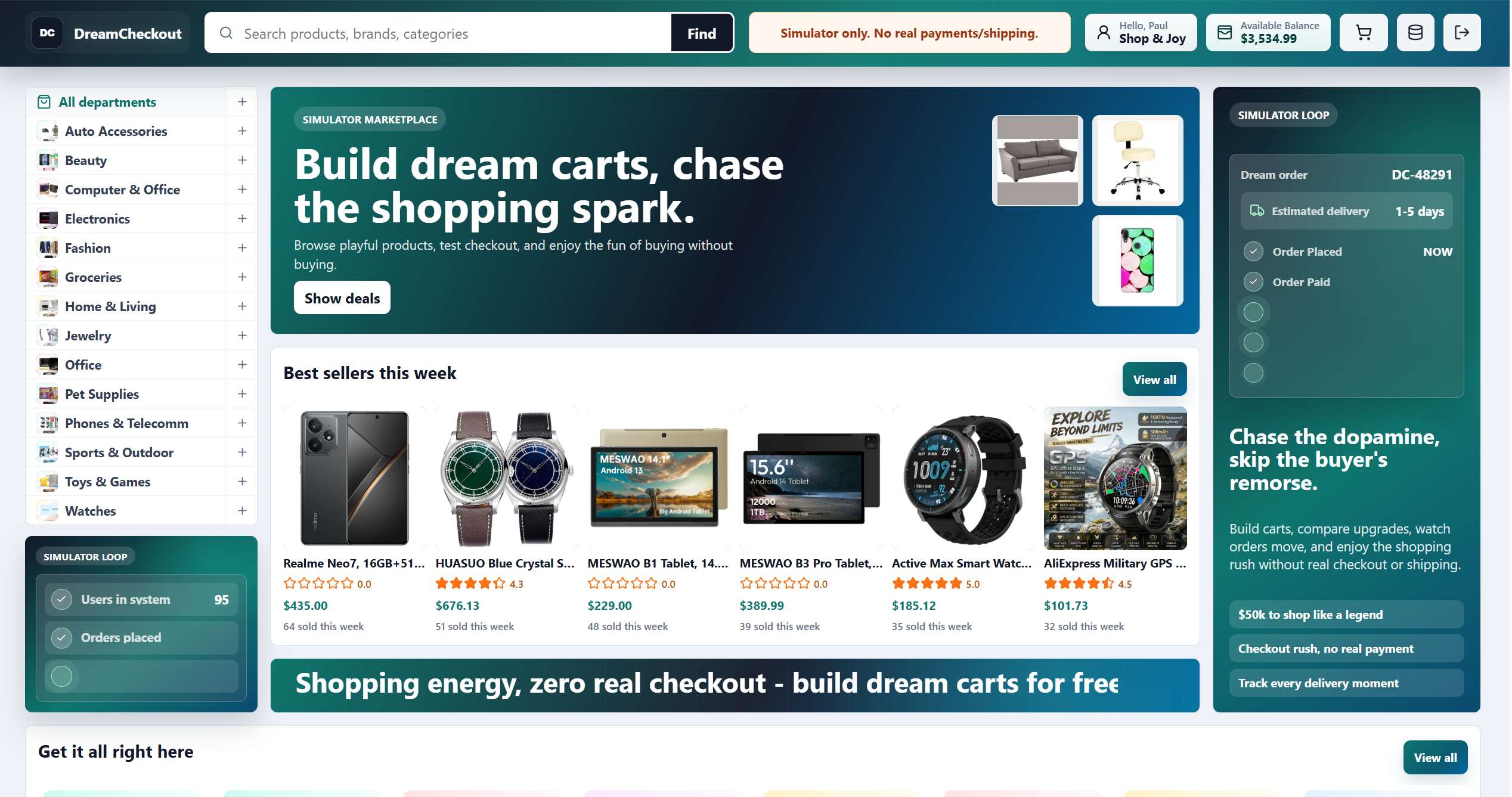
The catalog creates the first layer of a fake online shopping simulator: product discovery, categories, prices, ratings, visual browsing, and a clear simulator-only notice.
Filters and product grid
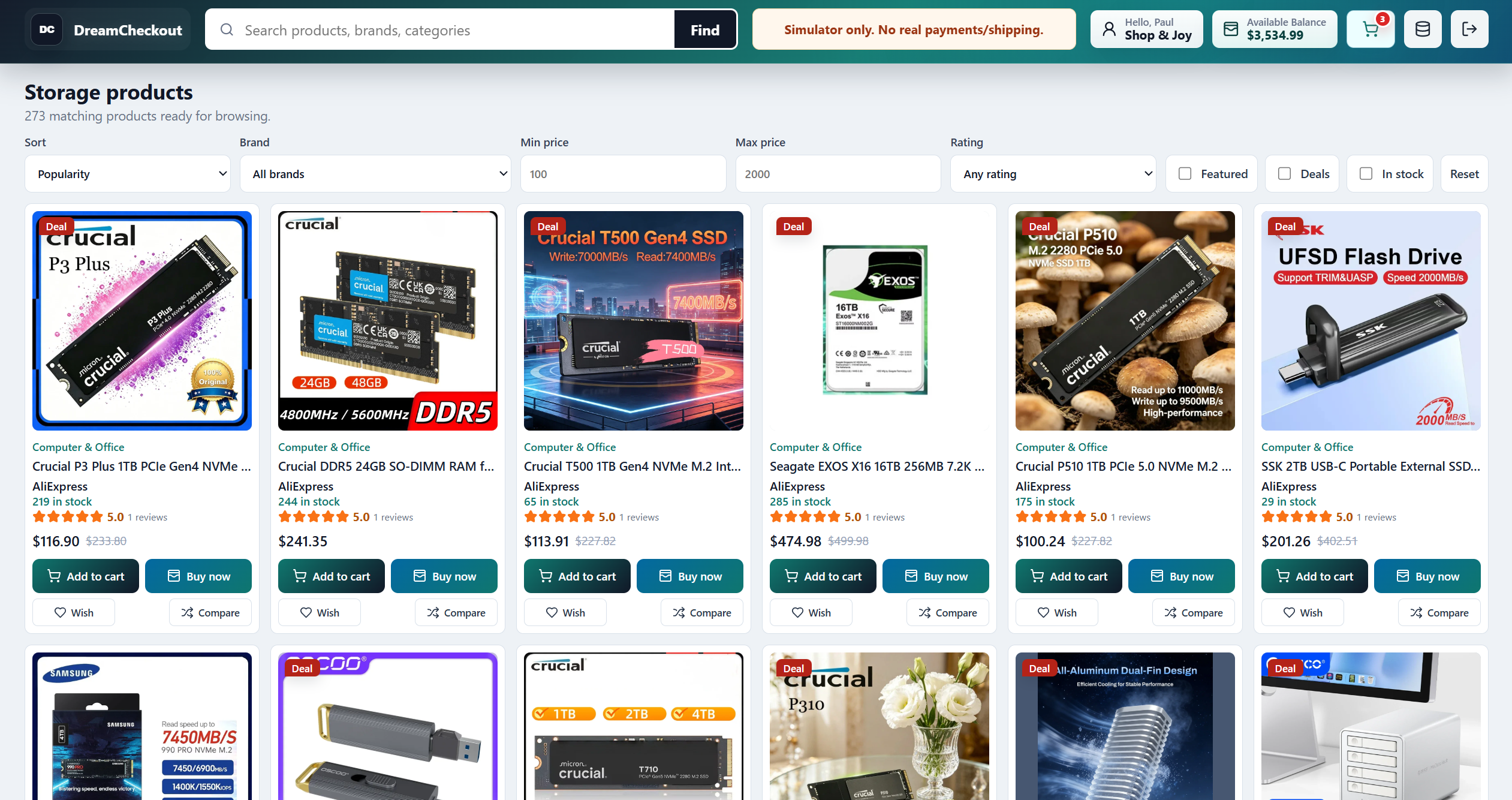
Sorting, brand filters, price ranges, rating filters, deals, stock, wishlist, compare, add-to-cart, and buy-now buttons make the fake store feel like a real ecommerce surface.
Why carts work
A cart turns vague desire into something you can actually inspect
Before a product enters a cart, the desire can feel like a cloud. It is just "I want something." That vague feeling is hard to argue with because it has no shape. A cart gives it shape. Suddenly the urge becomes five products, three categories, a total price, repeated brands, similar colors, or a story about the life you are imagining. That makes the desire easier to read.
The most useful question is not "Should I buy this?" right away. A better first question is "What job is this cart doing for me?" A cart full of blankets, pajamas, headphones, and tea may be about rest. A cart full of watches, shoes, and jackets may be about confidence. A cart full of storage bins, desk tools, and kitchen gadgets may be about control. Once the emotional job is visible, you can choose a better response.
DreamCheckout makes this reading process easier because the cart does not demand a real payment. You can be honest with the fantasy. You can add the expensive thing, the unnecessary thing, the aspirational thing, the comfort thing, and the practical thing. The point is not to judge the cart. The point is to see it.

Stress, desire, and delayed spending
Composite consumer psychologist
The useful moment is the gap between wanting and paying. A simulator can widen that gap without shaming the desire.
Generated composite portrait. This is not a real person or a quoted clinician.- Shopping urges often carry emotional information, not only product intent.
- A cart makes the urge visible enough to inspect.
- A simulator is a pause tool, not therapy or medical advice.
Dopamine and delay
The no-spend loop gives the brain progress without immediately rewarding spending
Online shopping feels good because it offers novelty, choice, and progress. Search results create possibility. Product pages create imagination. Reviews create confidence. The cart creates ownership-before-ownership. Checkout creates closure. Real stores attach this sequence to real money. DreamCheckout keeps the sequence but changes the consequence.
That matters because the brain often treats progress as reward. Pressing a checkout button can feel like finishing a task. Seeing an order confirmation can feel like a clean decision. Watching tracking statuses can feel like anticipation. In DreamCheckout, those signals are still satisfying, but they are part of a clearly marked simulator. The user gets the shape of progress without an automatic bill.
Delay is the practical benefit. If you use DreamCheckout first, you do not have to decide in the hottest moment. You can let the shopping spark pass through a simulated flow, close the loop, and revisit the item later. Many urges fade when they are no longer urgent. The ones that remain can be handled more calmly with real budgeting and research.
Interface proof
Cart, checkout, and account evidence
Cart and checkout path
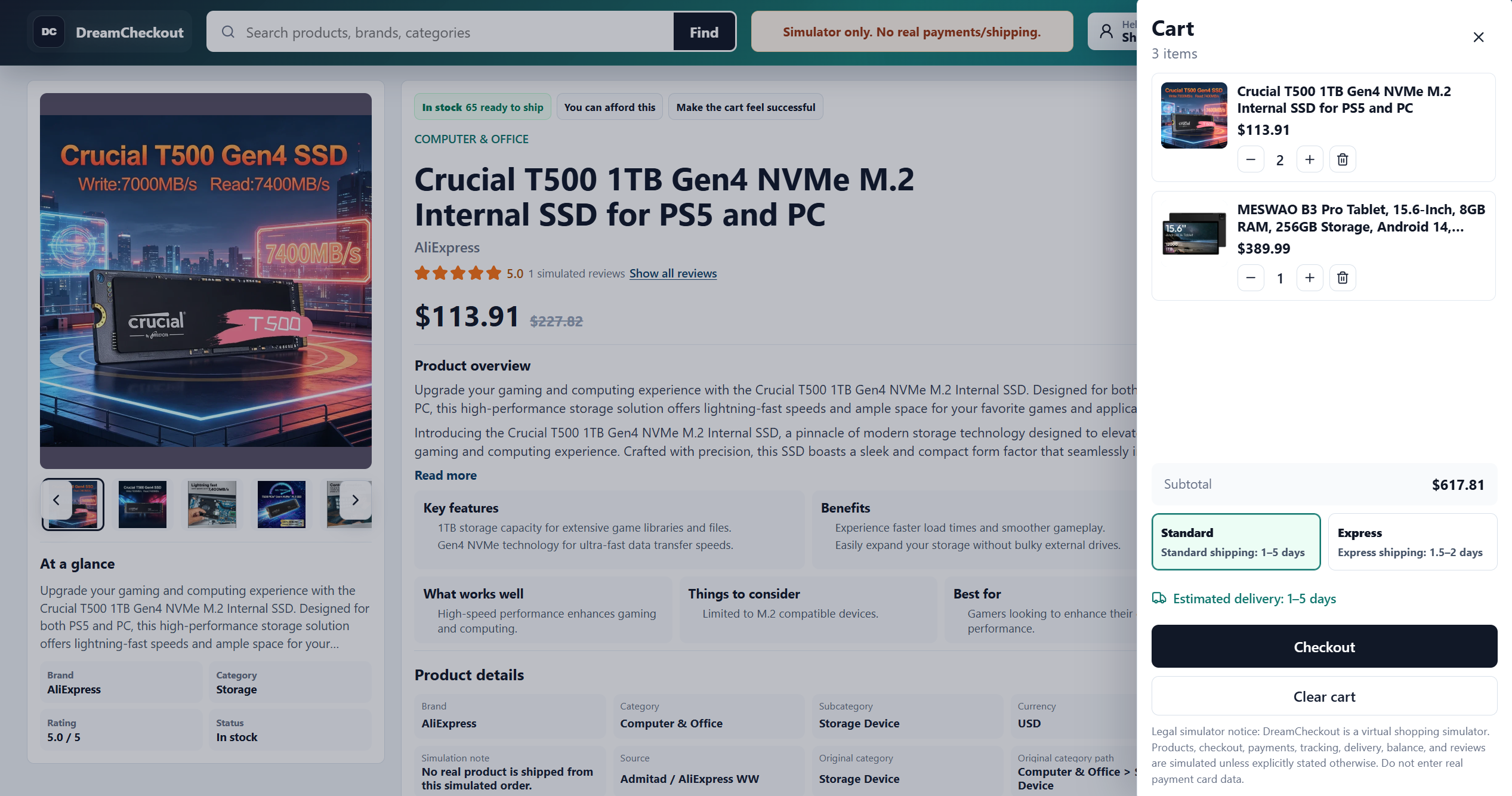
The cart drawer turns browsing into a visible list, shows subtotal and shipping choices, and gives the user checkout-shaped closure without a real payment card.
Account and virtual balance
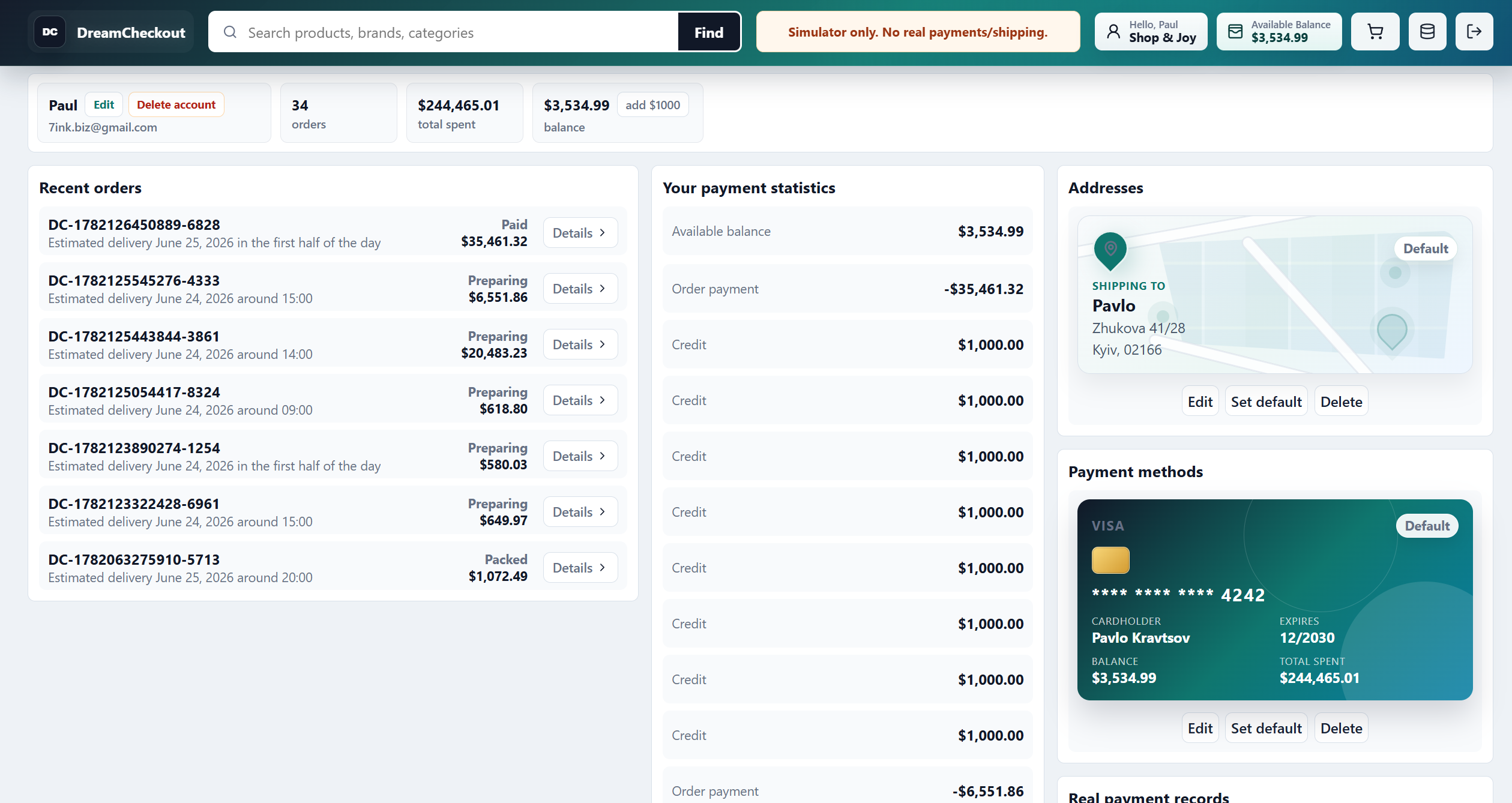
The account area makes the simulator feel complete: recent orders, payment statistics, virtual balance, saved address, and a fake payment method remain inside the no-real-transaction frame.
A real routine
How to shop without spending money in a way that actually helps
Start with a small rule: one mood, one cart, one checkout. Pick the feeling you are trying to satisfy. Are you looking for calm, beauty, control, status, comfort, play, preparedness, or a reward? Then browse for products that match that feeling. This prevents the session from turning into endless scrolling. It makes the activity intentional without making it joyless.
Next, build a cart with a limit. Three to seven products is enough for a pattern to appear. Add what pulls your attention, then stop and read the cart. Give it a name. "I want my evenings to feel softer." "I want to look more put together." "I want my desk to stop annoying me." "I want a tiny victory after a stressful day." The name is often more valuable than the products.
Finally, choose the ending. You can leave the cart as a wishlist, complete a simulated checkout for closure, or compare the products and remove anything that no longer fits the mood. If one product still feels important tomorrow, move it into a real decision process: check budget, compare alternatives, verify real product details with the actual seller, and decide deliberately.
Real-life value
The simulator can reduce clutter, returns, and regret by catching weak desires early
A weak desire can be expensive when it goes straight to checkout. The item arrives, the emotional peak has already passed, and now the user has a box, a charge, and a small task: keep it, return it, hide it, justify it, or forget it. Shopping without spending money catches many weak desires before they become physical objects.
This is useful even for people who are not dealing with serious shopping addiction. Everyone has tired moments. Everyone has small cravings for improvement. Everyone occasionally wants a purchase to stand in for rest, confidence, control, or celebration. A simulator gives those moments a place to play out without creating cleanup work afterward.
The result can be better real shopping, not no shopping. When fewer impulsive purchases survive, the purchases that remain are easier to respect. You can spend on things that solve repeated problems, fit a plan, or still look good after the excitement fades. DreamCheckout should make real purchases slower, clearer, and more intentional.
Interface proof
Cart, checkout, and account evidence
Tracking interface
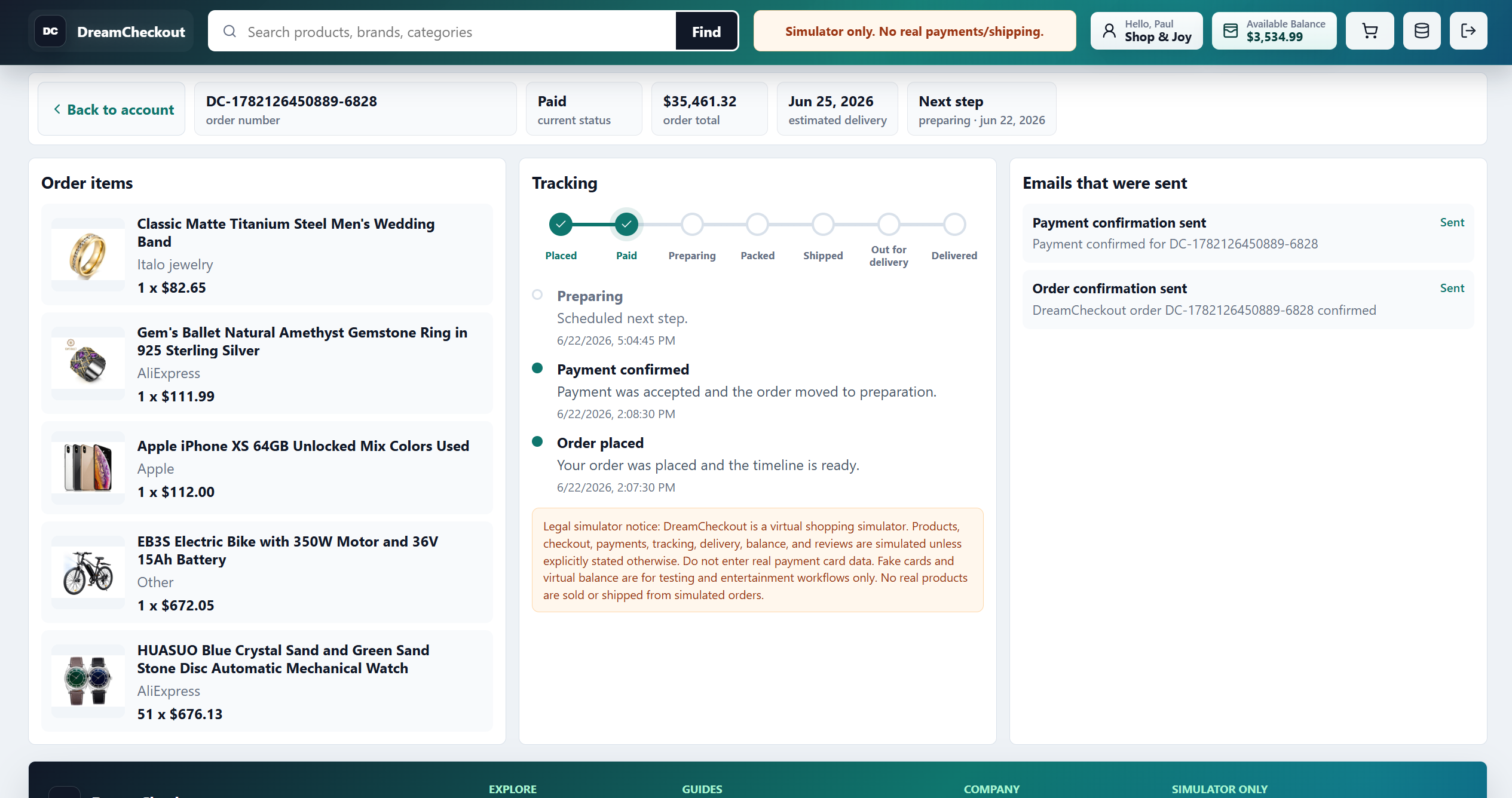
The tracking interface completes the simulated order story with item lists, status steps, email events, and an explicit legal simulator notice.
Order confirmation email
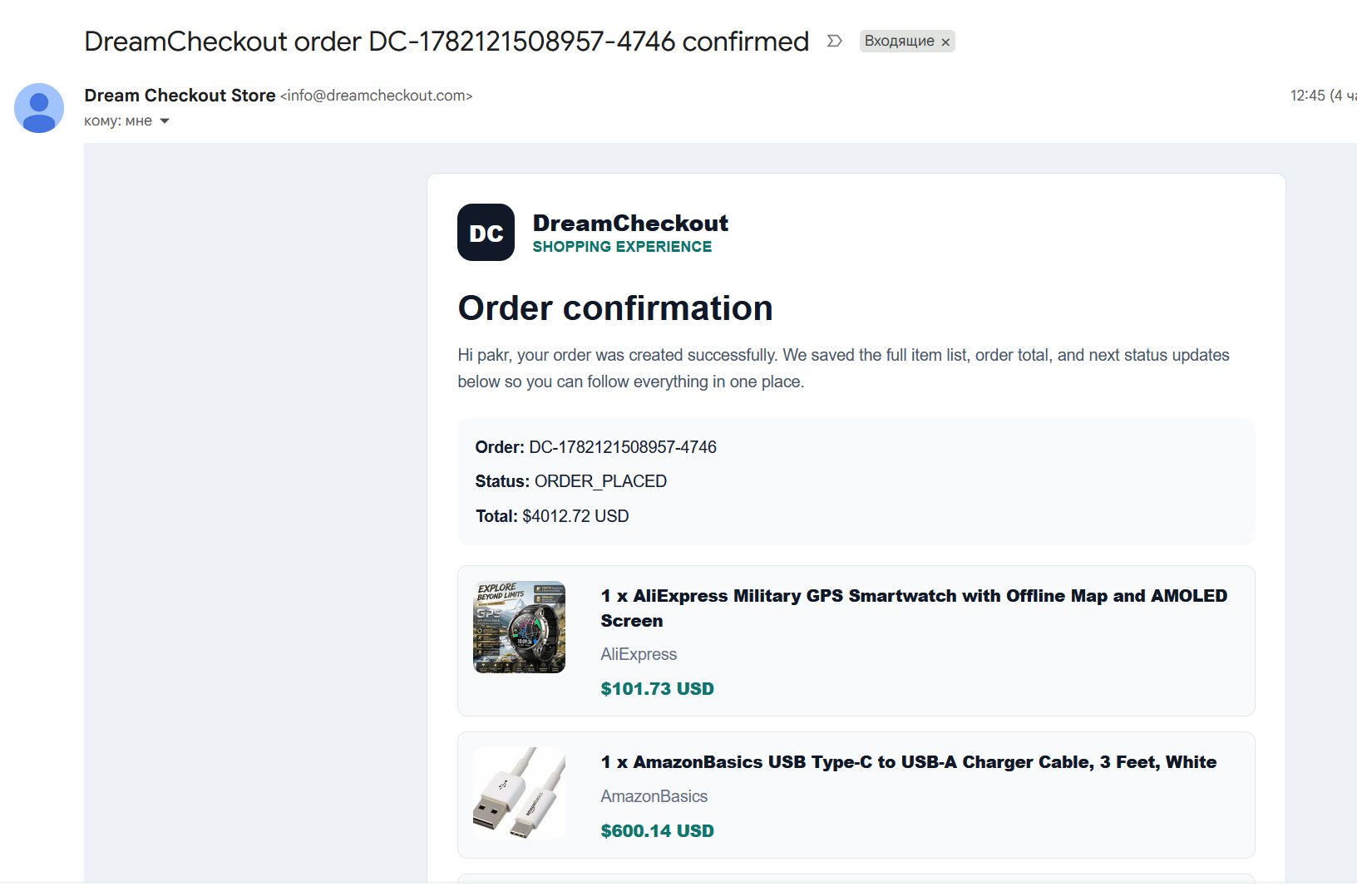
The order confirmation email extends the fake shopping loop beyond the browser with a receipt-like structure, item cards, order status, and branded simulator identity.
Budgeting
No-spend browsing works best when it supports a real budget, not when it replaces one
DreamCheckout is not financial advice, and a fake cart does not create a budget by itself. The simulator is a pause tool. It can help you notice what you want before money moves. The actual budget decision still belongs in the real world: income, bills, savings, debt, priorities, household needs, and planned spending.
One practical method is the pretend-to-planned rule. If a simulated item still matters after 24 or 72 hours, add it to a real wishlist with a date and a spending category. If it still matters after the next budget review, then it may deserve a real purchase. This turns impulse into a proposal instead of an order.
Another method is category awareness. If every simulated cart contains clothes, gadgets, groceries, or home decor, that pattern can guide real limits. You may not need to eliminate the category. You may need a monthly amount, a waiting period, or a replacement rule: one new item only when one old item leaves.

Why ecommerce signals feel rewarding
Composite retail strategist
Product grids, cart badges, checkout steps, and tracking timelines are progress signals. DreamCheckout keeps the signals while removing real payment.
Generated composite portrait. This is not a real person or a quoted retail executive.- Discovery, filtering, carting, checkout, and tracking create the shopping ritual.
- Realistic UX has to be paired with explicit simulator boundaries.
- The best no-spend experience feels familiar but never deceptive.
Boundaries
The experience should feel satisfying, but never confusing
The simulator boundary is not a boring legal detail. It is what makes the whole idea safe. DreamCheckout can use product images, prices, ratings, cart buttons, checkout screens, tracking, emails, and reviews because it also repeats the truth: this is virtual shopping. Products are not sold or shipped through simulated checkout unless something is explicitly stated otherwise.
Users should not enter real payment card details into simulator-only surfaces, should not treat fake tracking as a carrier promise, and should not treat displayed prices as retail offers. Product information may be imported, generated, incomplete, outdated, or wrong. It supports the simulated browsing experience, not a real purchase decision.
For people who experience severe distress, debt, secrecy, or loss of control around shopping, a simulator can be one small friction tool, but it is not therapy. The healthier use is conscious and finite: browse, cart, reflect, stop. A good no-spend session should leave the user lighter, clearer, or amused, not more desperate to buy.
Screenshots
How the DreamCheckout interface supports no-spend shopping
The catalog screenshot shows the first promise of shopping without spending money: the user can browse a real-looking product surface without immediately entering a real store. Product images, categories, prices, ratings, and recommendations create the familiar spark of ecommerce. The simulator notice keeps that spark from becoming confusing.
The filters screenshot shows why the experience feels more useful than a simple wishlist. Sorting, brand filters, price ranges, rating controls, deals, featured toggles, and stock filters let the user shape the catalog. That control is part of the reward because it makes a messy desire feel organized.
The cart screenshot is the practical center of the page. A no-spend shopping session needs a place where desire becomes visible. The cart drawer shows item thumbnails, quantities, subtotal, shipping choices, and checkout controls. In a real store, that structure pushes toward payment. In DreamCheckout, it becomes a holding area for wants.
The account, tracking, and email screenshots show the rest of the loop. Shopping without spending money is not only browsing. It can include a virtual balance, simulated order history, tracking states, and a confirmation email. These details give closure without creating a real purchase.
Expert perspective
Why experts frame no-spend shopping as a pause, not a ban
A consumer psychologist would likely start with the difference between suppression and redirection. Suppression says: do not want the product, do not browse, do not click. Redirection says: the desire can move somewhere safer first. DreamCheckout is built around redirection.
A retail strategist would focus on the fact that ecommerce has made browsing pleasurable by design. Product grids, filters, ratings, carts, and checkout steps are all progress signals. Shopping without spending money works because it preserves those progress signals without attaching them to real payment.
An ecommerce lifecycle expert would point to the confirmation and tracking layer. In normal retail, the order confirmation, shipping update, and delivery state keep the purchase alive. In DreamCheckout, those same lifecycle elements can close a fake order and support reflection.
All three perspectives agree on the boundary. The simulator should be honest, finite, and clear. It should not pretend to ship products, collect real card data, or claim to treat compulsive buying. Its value is narrower and more credible: it gives a shopping urge a safe structure before real spending begins.
No-spend examples
Examples of useful no-spend sessions
A comfort session might happen after a stressful day. The user builds a cart of blankets, lamps, tea, headphones, and soft clothes. Instead of buying all of it, they read the pattern: I want rest.
A confidence session might include shoes, jackets, watches, skincare, or accessories. The user can enjoy the fantasy without paying for every version of it. Later, they can ask which product actually supports the person they want to become.
A control session might include storage, office supplies, cables, cleaning tools, or kitchen organizers. The cart may reveal that the real need is order. The user can choose one real task, like clearing a desk, before buying tools for a future organized self.
A gift session might include several possible presents. DreamCheckout lets the user compare ideas without pressure. If one gift still looks right later, it can move into a real purchase plan. If not, the fake cart still helped clarify the theme.

Email, tracking, and cart recovery loops
Composite ecommerce lifecycle expert
The post-checkout layer is where shopping becomes a story. In a simulator, that story can create closure without a parcel.
Generated composite portrait. This is not a real person or a quoted product leader.- Confirmation emails make the simulated order memorable.
- Tracking pages turn a fake decision into a visible sequence.
- Abandoned-cart reminders should invite reflection, not pressure.
Final note
The win is not spending zero forever; the win is spending with more choice
Shopping without spending money should not be framed as never buying anything. Real purchases can be useful, beautiful, generous, practical, and worth planning. The problem is not buying. The problem is when every emotional spark moves too quickly into payment.
DreamCheckout gives that spark a place to go first. A user can browse, build, compare, fake-checkout, track, and reflect. If the desire fades, the simulator protected the user from a weak purchase. If the desire remains, the user can make a real decision with more patience.
That is the page’s core promise: keep the enjoyable part of shopping, remove the automatic charge, and let real money enter only after the hot moment has cooled.
Common mistakes
What makes no-spend shopping stop working
The first mistake is treating the simulator like an endless feed. Shopping without spending money works best when the session has a container. One mood, one cart, one fake checkout if needed, and one exit. If the user keeps scrolling for an hour, the tool may become another source of overstimulation rather than a pause.
The second mistake is using the fake cart to justify a real purchase too quickly. The cart should create time, not remove it. If an item still feels important tomorrow, it can move to a real budget review. If the user jumps from fake checkout directly to a real store, the simulator did not get a chance to cool the urge.
The third mistake is ignoring repeated patterns. If every no-spend cart points to the same need, the signal deserves attention. A repeated comfort cart may mean the user needs rest. A repeated control cart may mean the user needs a simpler environment. A repeated status cart may mean the user is chasing confidence through objects.
The fourth mistake is expecting the simulator to solve serious financial or mental health problems alone. DreamCheckout can help create friction and awareness, but it is not therapy, counseling, or debt support. When spending feels uncontrollable, outside support matters.
FAQ
Questions people ask about shopping without spending money
Is it still shopping if nothing is bought? In the emotional sense, yes. The user still browses, compares, chooses, carts, and may complete a simulated checkout. The difference is that ownership and payment are removed from the loop.
Can it make real shopping worse? It can if the session becomes endless or if the user treats it as a warm-up for real checkout. That is why DreamCheckout should be used as a pause with an exit, not as a bridge straight into a retailer.
Can it help with budgeting? It can support budgeting by delaying unplanned purchases and making wants visible. It does not replace a budget. The real decision still needs income, bills, savings, debt, goals, and household priorities.
Why use DreamCheckout instead of a normal store wishlist? A normal wishlist lives inside a store that ultimately wants payment. DreamCheckout keeps the entire loop inside simulation, including cart, checkout, tracking, account context, and email. That makes the boundary clearer for users who want the shopping feeling without a real charge.
Real-life playbook
Four simple ways to use it when the urge to buy appears
Add only three products that match the mood you want. The limit keeps the session intentional and makes the pattern easier to read.
Name the cart in one sentence. If the name is "I want rest" or "I want control," the real solution may not be a product.
Complete the fake checkout today. If the desire still feels useful tomorrow, move it into a real budget review.
Treat a cooled impulse as success. You got the shopping feeling without adding a charge, package, return, or regret.